Chapter 1
Bound for the Promised Land
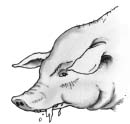
Joseph Shabosh dumped the last bucket of corn slop into the hollowed-out log trough and shook his head in disgust as the snuffling hogs thrust their snouts into the gooey mash. "Dumb, ugly brutes," he muttered, "good for nothing except lying in a stinking mud hole to keep off the gnats and make more work for me."
The Indian boy scrambled over the post-and-rail fence of the village pigpen with the empty buckets and dropped down onto the ground beside his friend David Heckstein, who was propped against a tree stump. "Why did the elders decide to raise pigs and cows, anyway?" Joseph complained. "We could get plenty of meat for the whole town if we just went hunting more often."
David rolled his eyes in mock boredom. "Sooner or later you bring everything around to hunting, don’t you!" Then he grinned. "Cheer up, Joseph. You’re almost fourteen. Surely your father will take you on a hunt soon—at least by next spring."
At first glance, the two boys might have been brothers. Both wore simple, homespun tunics over loose leggings and leather moccasins. Their hair hung straight to their shoulders in the plain style of the Christian Indians, who wore beads or feathers or shaved heads. But a closer look showed there were marked differences between the two.
Joseph, the older boy, was on the verge of manhood, his body lithe and strong. He had the thick, black hair and dark eyes of the Seneca Iroquois, and his smooth, dark skin glowed with health. Twelve-year-old David, on the other hand, was small and slight—too slight for his age. Though his hair hung straight to his shoulders like the other Indian boys, it was not black but brown, and his eyes were blue-gray—inherited from his Moravian missionary father, Berthold Heckstein, who had been killed by hostile Indians when David was just an infant. But the boy’s dark lashes and eyebrows and warm, olive skin he had inherited from his Mohegan mother. He had a quick, open smile—but pain was often etched around his eyes.
For a few more moments, the two friends loitered on the warm grass, enjoying the late-afternoon September sun that bathed the Susquehanna River valley. "The leaves are turning color," David murmured as a breeze rattled the maples and birch trees above their heads.
Joseph jumped up. "And the sun is hiding in the trees! I better get you back in time for supper or your mother will have my hide." Bending low, he swung David onto his back, steadying the lightweight boy with one arm bent back under David’s hips, while he grabbed the empty buckets with his free hand. Being careful not to jostle David too much, Joseph scurried back toward the neat row of log houses and bark huts that made up "Tents-of-Peace," the Christian Indian town along the Susquehanna.
The unusual "horse and rider" had turned a corner around the first log house when suddenly Joseph stopped. "Look," he said, panting under his load.
David, his arms around Joseph’s neck, peered curiously over the boy’s shoulder. A large group of townsmen were gathered around two white men in the hard-packed dirt street near the mission house. The townsmen were mostly Iroquois—the confederacy of Six Nations that included the Seneca, Onondaga, Cayuga, Mohawk, Oneida, and Tusca-roras—and a few Mohegan Indians as well. Joseph wasn’t surprised that one of the white men was John Heckewelder, the young, square-faced Moravian missionary who had been living among them the past year. But the other—
"It’s Father Zeisberger!" David cried. "He’s back!"
Joseph grinned and began trotting eagerly toward the mission house. David Zeisberger, the spiritual leader and pastor of the two hundred Christian Indians who had settled along the Susquehanna River, had been gone the better part of 1771 on one of his missionary journeys to some of the Indian tribes farther west in the wilderness of Pennsylvania and Ohio. During Zeisberger’s absence, Brother Heckewelder had been assigned to oversee the mission.
But now Father Zeisberger was back! Joseph was glad; he liked and respected the thin, wiry man. The pastor was only slightly taller than Joseph himself, with a plain, serious face. He spoke plainly, too—he was straight to the point, honest, and he kept his word—which, Joseph thought wryly, was unusual among "the English."
But even though Father Zeisberger and Brother Heckewelder had white skin, they weren’t English. They had come to America from Moravia—a far-off place across the ocean like England—but they spoke a funny language called German. Fortunately, both men had learned the Iroquois dialect used by the Six Nations.
As the two boys drew closer to the knot of men talking excitedly outside the mission house, Joseph heard David Zeisberger raise his voice and say, "Brothers! Let’s go inside, and we can discuss the matter in a reasonable manner. We all have opinions, but we must seek God’s mind about what we should do."
Seeing the boys, Joseph’s father, John Shabosh, separated himself from the group and motioned to them. "Joseph! Are your chores done?"
"Yes, father, but what—"
"Then take David back to his mother. Father Zeisberger has returned and has called a meeting of the town council. I will be late for supper. Go on now!" he ordered sternly. "This isn’t a meeting for boys. You shall hear soon enough." As Joseph reluctantly moved to obey, John Shabosh called after him, "And rinse out those buckets!"
As Joseph carried David on his back to the Heckstein cabin, made in Iroquois fashion of poles and bark, they were silent in their mutual disappointment at being sent away. What was the meeting about? Had something happened?
Anna Heckstein was greatly relieved to see them. "There you are! You’ve been gone so long, I was getting worried. Father Zeisberger has returned, did you see?" She grew more serious. "Are you all right, David? Maybe the hog pens are too far—"
"I’m all right, Mother," David insisted as Joseph lowered him to a bearskin on the floor of the cabin. He turned imploring eyes on his friend as Joseph rose to leave.
Joseph leaned close to his ear. "I’ll come tell you as soon as I find out what’s going on," he promised. "Besides, I need help with my lessons tonight."
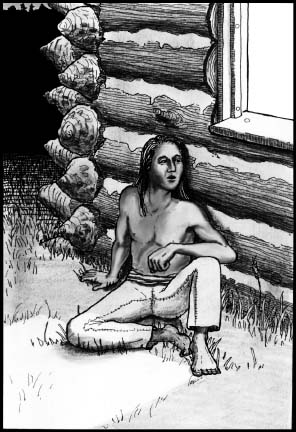
Burning with curiosity, Joseph dumped the buckets and cut around behind the row of log houses to the back of the mission house. The windows were open to the golden twilight of the warm, September evening. Good, Joseph thought, creeping beneath one of the windows and finding a comfortable spot with his back to the log wall. He could hear perfectly.
"What do you mean, the Iroquois have sold our land to white settlers?" an unseen voice cried in astonishment from somewhere within the house. Joseph recognized it as that of John Myers, a young Onandaga Iroquois who had cast his lot with the Christian Indians and had even taken a Christian name. "The Iroquois gave us this land along the Susquehanna seven years ago!" John Myers continued. "In good faith, we have built homes and planted crops!"
"I know, I know," came David Zeisberger’s calm voice. "God has given us a haven of peace and prosperity these past seven years—and all of us hoped it would remain so for many years longer."
"Father Zeisberger," spoke up another voice in Iroquoian, but with a distinct German accent, "can’t we work this out? Five years ago, there was a dispute about the land, but you went to the Grand Council of the Six Nations, and the dispute was settled in our favor."
"That’s true, Brother Heckewelder," said Zeisberger. "But even if we challenge the sale of the land, the fact is, the white settlers are moving closer and closer, bringing their liquor and ambitions with them. If we stay, we will once again be caught up in their wars and squabbles. Do you forget that during the last war between the French and the English, we who refused to fight were suspected by both sides? Even our Indian cousins from the various tribes turned against us because we would not take up weapons. There was so much confusion we had to cease mission work altogether!"
"He’s right." Joseph immediately recognized his father’s grave voice. "I don’t want to have to ask the English for ‘protection’ again—like the horrible winter they confined us in the army barracks in Philadelphia."
There was a strong murmur from within the log house. Even Joseph, eavesdropping beneath the window, remembered the angry white mobs who wanted to kill all the Indians—friend or foe, Christian or pagan, peaceful or warlike—it didn’t make any difference. That was the mob which had yanked David, only four years old at the time, out of his mother’s arms and—
Joseph’s thoughts were interrupted by Zeisberger speaking again. "On my last trip, I was invited by Chief Netawatwes to come visit the Delawares in Ohio. He is eager to have us establish a mission among the Delawares, and he promised us land in the valley along the Muskingum River. Before I came here, I talked with the leaders at the Moravian church headquarters in Bethlehem, Pennsylvania, about Chief Netawatwes’ invitation and about the land dispute here along the Susquehanna."
He paused. This time no one interrupted. Everyone waited.
"The Moravian leaders are recommending," the pastor went on, "that we move our mission west to the Muskingum. It is a great opportunity to bring the Gospel to the Delawares. And in Ohio, we will once again be hundreds of miles away from the white settlers and will be able to live in peace."
Again there was silence within the log house. Joseph, sitting just outside, was so shocked he could hardly breathe. Leave Tents-of-Peace? But why? The band of Christian Indians, pushed from place to place ever since the bloody war between the French and English, had been so grateful to find a home along the Susquehanna. The Moravian missionaries had encouraged the Christian Indians to give up the hunting life with its uncertainties and long absences for the more stable life of farming and raising livestock. The land was rich, producing plenty of corn not only for themselves but to give away to hungry Indian tribes nearby or hunting parties that passed through.
Besides the pigs, the town raised chickens, a large herd of cattle and milk cows, and each family had a big vegetable garden behind its log house. Trade goods included well-crafted canoes and the maple sugar they harvested from the forest in late winter. The careful workmanship of the Christian Indians was well-known. Not only that, but the town had a church and a school and a mission house. What would become of all this?
"Our leaders speak well." Joseph heard his father break the silence. "We will need the winter months to get ready. There is much to do. But by spring, we will go as you have said, Father Zeisberger. It is a call for us to leave our home for a better one—like the Hebrew children setting off through the wilderness to the Promised Land. God will be with us."
At his father’s words, Joseph felt a shiver of excitement. A trip into the wilderness! Why, it would be like the tales he’d heard about the old ways, living off the land, hunting every day, fighting off wild beasts—
A small, gleeful smile touched his lips. Surely they would have to leave the stupid pigs behind.
And then, just as suddenly, the smile faded as a horrible thought struck him. David couldn’t walk. Would they have to leave him behind, too?
© 1996 Dave and Neta Jackson