Chapter 1
The White Ma and the Royal Canoe
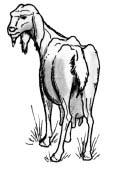
Pressing her body against a twisted mangrove tree, Imatu peered around the trunk. There. She could see the goat a short distance away, flicking its tail and munching the grass along the riverbank.
I’ll catch you now, Imatu thought grimly. A light rain was falling steadily through the forest, covering any noise she might make.
But before Imatu could move, the goat threw its head up, gave a startled leap, and disappeared into the wet, dripping bushes.
"Wicked goat!" Imatu fumed, stamping her foot in frustration.
She had been trying to catch the runaway since noon and had followed it all the way to the Calabar River. At first she’d been glad her mother had sent her after the missing goat—that meant she didn’t have to go to the funeral in Ifako, the next village. Imatu hated funerals. All the drinking made everyone crazy, and the witch doctor was sure to accuse someone of casting a spell on the person who had died.
But the light was slipping away in the late, rainy afternoon, and Imatu didn’t want to be in the forest after dark. She’d been so close to catching that goat! She knew she hadn’t made any noise. What had startled it?
Then she heard it. Chanting . . . coming from the river.
The chanting grew louder, accompanied by the steady swish, swish of paddles dipping into the water. Who was coming up the river? Imatu’s heart beat faster; she was tempted to turn and run back to the village. But curiosity moved her feet quietly through the wet grass, stepping over gnarled tree roots and tangled vines, toward the edge of the river.
The girl crouched behind a bush and listened. She could make out some of the words now . . .
Ma, our beautiful, beloved mother,
Is on board.
Ho! Ho! Ho!
And then the canoe came in sight. Imatu gasped. She had never seen a canoe like this one! It was twice as long as the fishing canoes the men of her village hollowed out of fallen tree trunks. From front to back, strong paddlers lined either side—more than she could count!—their dark skin glistening in the rain. A steersman stood in the back, beside a pole with a long banner flying out behind. But strangest of all was the little "hut" in the middle of the canoe, covered on top by palm leaves, with brightly colored cloth curtains fluttering on all sides.
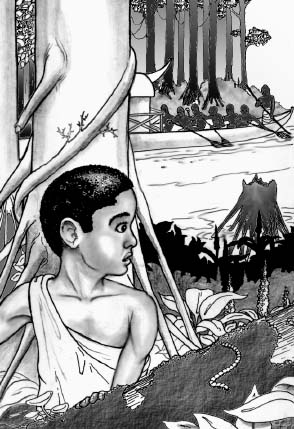
The canoe shot past her, on up the river. Imatu ran after it, safely hidden among the bushes and trees of the forest. This was no fishing canoe. It couldn’t belong to an ordinary village chief. This must be a king’s canoe.
Whump! A hidden tree root sent Imatu sprawling on the ground. She scrambled to her feet but she could no longer see the canoe, though she could still hear the chanting . . . Ho! Ho! Ho! Ignoring her stinging toes and knees, Imatu ran faster. She had never seen a king before—the Okoyong people had no king. So where did this king come from? And where was he going?
Suddenly the chanting stopped. Coming over a little rise beside the river, Imatu quickly crouched down. The canoe had pulled up onto a little strip of sand. The front paddlers hopped out and pulled the canoe halfway out of the water and started to unload bags and boxes. But Imatu’s eyes were riveted on the little hut.
The curtains parted and a young boy and girl crawled out. Right behind them, an older boy about Imatu’s age came out, holding a small child on his hip. The children scrambled over the side of the big canoe, squealing, obviously glad to stretch their legs after being cooped up in the little hut.
But where was the king?
The curtains parted again and a woman came out, holding a baby. Imatu shook the rain out of her eyes; the fading light must be playing tricks on her! She squeezed her eyes shut, then opened them and stared again.
The woman’s skin had no color! It was as white as the goat Imatu had been chasing all afternoon. And her hair! It was reddish orange—as orange as the yams Imatu and her mother dug out of the ground to roast and eat.
Imatu had never seen a white person before. What was a white woman doing in a king’s canoe? Imatu’s heart thudded so loudly in her chest she was afraid the people from the canoe could hear it, too. Had this strange woman brought warriors to attack her village while everyone was away at the funeral? Everyone, that is, except Imatu’s mother and a few slave women. . . .
Just then the strange white woman called out to the oldest boy: "Okin! Gather the children and follow that path." Imatu was startled; the woman was speaking in Efik, her own language! "And, Akani," the woman said to the steersman, "the children and I are going ahead. You organize the bearers and bring the supplies. We need to get to Ekenge before dark . . . about four miles into the forest."
Ekenge! That was Imatu’s village. The white woman was going there!
Imatu jumped quietly to her feet, still careful not to be seen, and ran as fast as she could through the tangled underbrush toward her village. When she thought she was well ahead of the strangers, she found the path that led from the river to the village. The rain had slowed to a drizzle, but the path was wet and slippery.
Daylight was almost gone when Imatu stumbled into the nearly deserted village. Ekenge, like other Okoyong villages, was a loose cluster of family compounds. Each compound consisted of several huts grouped together behind a rough bamboo fence for a man, his wives, their children, several slaves, and assorted animals. Tonight the compound fires were cold—except for one.
Slipping in the mud, Imatu made her way toward the single fire flickering in the drizzling rain. Her mother, Inyam, was stirring a mush made of cornmeal under a palm-thatch shelter, while two old women—slaves of the chief—sat in the doorway of one of the huts.
"Mem! Mem!" Imatu called out, gasping from her run.
"Imatu? Did you find the goat?" her mother called back. Inyam was a handsome woman, large boned and strong.
"No . . . the goat . . . not important . . . woman coming . . ." gasped Imatu.
"What?" said Inyam angrily. "You came back without the goat? Go! Go now and find it, or the chief will beat us when he returns."
"Wait! Wait!" pleaded Imatu. "I came to warn you . . . a woman with many warriors . . . coming!"
"Woman? What woman?" frowned her mother.
"A white woman! In a king’s canoe!"
Inyam grabbed Imatu by the shoulders and gave her a shake. "You’re talking crazy! Who gave you gin to drink?"
Suddenly they heard the sound of children crying, coming from the forest path. Imatu’s mother stared in astonishment as the white woman with short, red hair marched barefoot and hatless out of the brush and into the muddy clearing, carrying a year-old infant. Clinging to her skirts were two children crying lustily. Imatu saw that the boy called Okin was right on her heels, carrying another whimpering child.
The two old slave women gave a fearful cry and scurried into the hut. But Inyam walked slowly toward the pathetic little group standing in the middle of the village. Imatu crowded close behind her, peeking around her mother’s back.
"Oh! I’m so glad to see you!" said the stranger, shifting the baby to her other hip. "I’m looking for Chief Edem, village of Ekenge."
Inyam looked the woman up and down. "You have warriors?" she asked.
"Warriors? No, no," the woman shook her head, trying vainly to shush the tired, wet children. "I come as a friend. I am a Jesus teacher."
Inyam frowned at the strange name. "Jesus teacher? Is he the king of the canoe?"
"The king of the . . . what?" Then the woman laughed. "Oh, the canoe! No, no. The canoe belongs to my friend, King Eyo Honesty VII of Creek Town. The king loaned me his canoe because I had no way to come up the river—"
Just then a man ran out from the forest path into the village clearing. Inyam tensed; Imatu recognized him as the steersman of the canoe.
"Ma! Ma Slessor!" the man cried, panting from his run. "The paddlers will not bring your supplies tonight. They say it is too dark; they are afraid of the evil spirits in the forest. They will come tomorrow."
For a moment the white woman’s shoulders seemed to sag. Then she lifted her head. "No, tomorrow is Sunday, God’s day of rest. I cannot ask them to work for me tomorrow. It must be tonight. Here," she said to a startled Inyam, handing the baby to Imatu’s mother. "Will you please take care of my children until I get back? It seems I must go shake the men myself. Come, Akani." And with that the woman plunged back into the now-dark forest, the steersman at her heels.
Inyam just stared after her, openmouthed, the baby screaming in her arms. Imatu tugged at her mother’s skirt and pointed to the pot of cornmeal mush still cooking on the sputtering fire. "We can feed them," she suggested, suddenly feeling sorry for the children, who had just been abandoned by their "mother" . . . or whoever that white woman was.
In a short while the five children were greedily stuffing cornmeal mush into their mouths and being fussed over by the two old slave women who had come out when the white woman left.
"No milk to drink," Imatu said, shrugging her shoulders at the boy named Okin. "I lost the goat."
G G G G
Imatu woke with a start. The rain had stopped, the baby was asleep in Inyam’s arms, and the white woman’s other children had curled up on mats inside the hut. But she saw the dancing light of many torches approaching the village and heard drums beating and drunken singing. Was it the white woman returning? . . . No, the torches were coming from the direction of Ifako. The villagers must be returning from the funeral.
Inyam had heard the commotion, too, and was trying to lay the baby down without waking it up when a tall man in a flowing robe strode toward their still flickering fire.
"Inyam!" he bellowed angrily. "Why did you not go to the funeral? You dishonor me and our sister village by your absence!"
Imatu’s mother scrambled to her feet, her eyes cast down. "I didn’t mean to dishonor you, brother-in-law," she said. "The goat that my dead husband left us—it ran away. Imatu and I had to find it, so that we do not presume further on your generous hospitality."
"A likely story!" roared the man, who was obviously drunk. "You probably untied it yourself to have an excuse not to go to the funeral, you insolent woman! And . . . what is this baby? Whose orphan did you snatch from the forest? Do you think our poor village can feed another mouth? I won’t have it! I—"
"Chief Edem!"
A powerful woman’s voice carried through the night, over the babble of voices slurred with strong drink. All eyes turned in the direction of the path that led to the river, and voices suddenly ceased. Into the circle of torchlight marched the white woman with red hair, followed by a line of unhappy-looking men carrying all sorts of boxes and bundles.
"Chief Edem," said the woman again in the Efik language, addressing Inyam’s brother-in-law. "The baby is my adopted child. I am Mary Slessor; do you remember me? You and I talked in a big palaver once before, almost two years ago, and you invited me to come to your village and teach ‘book.’ Well, I am here."
The drunken chief’s eyes bugged and his mouth opened and shut, but no sound came out. Imatu felt like giggling but dared not. And then in the silence she heard a forlorn "baaaa."
Attached to Mary Slessor’s wrist was a braided vine, and at the other end of the vine was the missing goat.
© 1994 Dave and Neta Jackson