Chapter 1
Knocked on the Head
I awoke in a strange bed, and then it came to me: it was September 19, 1853, and I was in Liverpool, England. But I also remembered with a sinking disappointment that Grandfather Thompson was sick in bed and couldn’t take me down to the docks.
Only my grandmother had met me at the train the night before. After a big hug, she explained, "I know, Neil, that coming from the country you have your heart set on seeing the ships tomorrow, but you’ll just have to wait until the captain feels better."
"That’s all right. I can wait," I assured her, but in the morning I didn’t feel so patient.
My grandfather was a sea captain, and since he had spent most of his life out to sea, I’d only seen him once before. But now that he had retired, he’d invited me to come stay with him and Grandmother for a while. "I’ll show you all the ships in port and introduce you to every captain," his letter had promised.
But now he was sick.
I got out of bed and looked out the small round window. It was just like a porthole in a ship. A lot of things in my grandparents’ house came from ships or the sea. There were brightly polished brass lanterns outside the front door, a big shell and a spyglass on the mantel, and a map of the world on the wall. The beams of the ceilings in the rooms were low and dark, and the "handrail" up the narrow stairs to the little room where I slept was nothing but a fat rope. I loved it all. Someday I wanted to go to sea, too.
The morning was bright but foggy. From my window the roofs of the neighboring houses seemed to float in a silver haze. Soon the sun would make a clear day of it.
Why wait for Grandfather? I thought. The water can’t be that far away. I can already smell the tang of salt air. I’ll bet I can find the docks easy enough.
In no time, I had snuck out of the house without disturbing Grandmother and made my way to the waterfront. I had never imagined there could be so many ships. I walked past about thirty of them—big and small—and there were still ship masts as far as I could see down the Mersey River around which the port of Liverpool was built.
This was great! I couldn’t wait until Grandfather
was better and could take me aboard some of the ships to meet the captains.
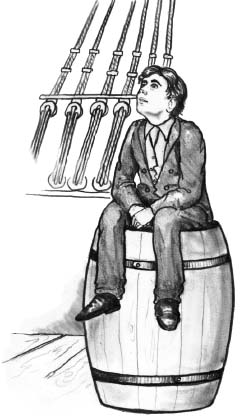
I stopped beside a small clipper ship. The name Dumfries was painted on its bow. The crew seemed about ready to cast off, so I climbed on top of a barrel to watch. Soon the sun broke through the mist, and some people walked down the gangplank.
When they reached the dock, they turned and waved to a passenger—a young man who looked only about twenty—who remained standing by the ship’s rail. I wondered where he was going . . . the lucky dog.
Suddenly, a ship’s officer—I could tell by the fancy way he was dressed—yelled, "Where’s the cabin boy? It’s time to cast off, and he’s nowhere to be seen!" The man came to the rail and looked up and down the dock, then yelled to two sailors below who were ready to release the huge ropes that held the ship secure. "You men! We’re short a cabin boy." He jerked his head toward the dock and said, "See to it."
"Aye, aye, sir!"
Just then I noticed that one of the women on the dock was sobbing into her handkerchief. The passenger on deck called down, "Mother, don’t cry. Please don’t cry. I’ll be home before you know it."
I was feeling sorry for the woman when suddenly strong arms grabbed me from behind and pulled me off the barrel. In an instant, I was being carried by the two sailors toward the ship. I’m tall for twelve years of age, and I struggled for all I was worth, but it was no use. I could not break free from their firm grasp. When I felt us bouncing up the gang plank, I began to yell for help.
"Hey, what are you doing to that boy?" someone shouted, but just then something hit me on the head, and everything went dark.
G G G G
When I woke up—the second time on that fateful Monday—I was not in my grandmother’s comfortable guest bed. The place was small and dark and damp, not much bigger than a coal bin. The back of my head hurt, and I felt myself swaying back and forth. It did not take me long to figure out that I was on board the Dumfries, on my way out to sea.
"Let me out of here!" I yelled. Again and again I called for help without any results. I tried not to panic, but I was scared to death. Why was I grabbed and taken on board? I know I should have waited for Grandfather to come down to the docks, but I hadn’t been doing anything wrong—just sitting on that barrel watching.
Then I remembered the officer yelling that the cabin boy was missing and telling the two sailors to take care of it—and he had nodded toward me! I was really frightened. I didn’t want to be a cabin boy—not now, not like this.
I started kicking the rough wall. Maybe I could find a loose board or a door that I could kick open. Again and again I kicked the boards, yelling at the top of my lungs.
Finally, someone opened the door of my small cell, and I found myself staring into the face of an African man. "Well, well, what do we have here?" he said. "A stowaway, eh?"
By now I was furious. "I’m no stowaway! I was forced onto this ship. I’m supposed to be back in Liverpool."
"Ha! A likely story," growled the seaman. "I say you’re a stowaway. Get out of there. I’m takin’ you to the captain. We’ll see what he says."
My heart sank. If the officer I’d seen was the captain, my goose was cooked. But at least I wasn’t locked up any more, so I followed along behind my "rescuer." Up on deck, everyone seemed busy adjusting the sails and getting things squared away. The officer who had ordered my capture was yelling orders. But I was relieved to see that land was not far off to the east. Maybe I can talk him into putting me ashore, I thought.
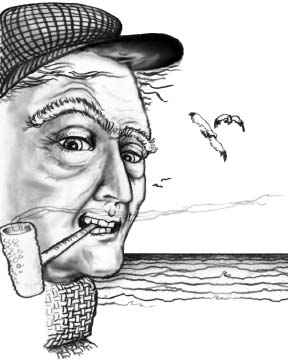
However, the sailor passed the officer and took me up some steps to the poop deck where the helmsman was holding the wheel that guided the ship. Beside him stood a large, muscular man. I thought he was just another sailor, plainly dressed in dark blue dungarees, a sweater, and a small-billed cap on his head. He stood there with his arms crossed staring off at the sea, while he puffed evenly on a short pipe.
"Cap’n," said the sailor who had me in tow, "I found this here stowaway up in the forecastle. What’ll we do with him?"
I was startled. This was the captain? For the first time, the man with the pipe took notice of us. His face was lean and lined, as though it had been chiseled out of brown ivory. His eyes were a brilliant blue under bushy white eyebrows. He didn’t look mean, but he sure looked firm. "What’s that, Jeffries? A stowaway? Why in heaven’s name, boy, would you want to stow away on a tea clipper bound for China?"
"I didn’t stow away," I protested. "I was just sitting on the dock watching. Some of your sailors grabbed me and carried me on board for no reason. They hit me on the head and locked me up below deck."
The captain frowned. "Mr. Henson," he called to the officer in the fancy clothes. "Do you know anything about this boy?"
"Yes, sir," said Henson as he strolled toward the poop deck, the brass buttons on his jacket shining brightly. "That there is our new cabin boy."
"Did you sign him on?"
"Waal, I haven’t got ’round to the formalities yet, but I’ll do so soon as we get squared away."
"Henson, did you shanghai this kid? I want a straight answer!"
"Yes, sir. That I did. Our signed cabin boy turned up missing when it was time to cast off, and this chap was just sittin’ on the dock needin’ a job."
"Henson, that is the last time you will shanghai anyone onto my ship. Is that understood? You’ve never sailed with me before, and I can see you have a few things to learn. If you want to remain my first mate, you’d better learn them mighty quick."
"Aye, aye, sir," Henson said with a smirk, and sauntered off again.
I was beginning to get worried. "Can you send me back to Liverpool?" I asked the captain.
The captain shook his head. "Don’t see how I can, boy. "Yonder goes our pilot boat. Could have sent you back on it, but it’s gone now."
I looked back toward Liverpool where the captain was pointing with the stem of his pipe to see a small boat disappearing in the distance.
Now I was really worried. "Can’t you call them back or something?"
"Nope. Besides, the pilot is a busy man; he can’t be running a ferry service."
"But my grandfather is a captain! I’m sure he would make it right with the pilot."
"A ship’s captain? What’s his name?"
"Captain Thompson."
"George Thompson?"
"Yes, sir. He knows everyone. He’ll make it right by you if you just get me back to shore."
"I’m sure he would . . ." The captain’s voice trailed off as he looked out to sea once more.
I looked around anxiously. "How about putting me on shore with that longboat? It’s not that far. I’ll—I’ll walk back to Liverpool."
The captain frowned. "Look, son, there’s no way. Now, I’m sorry you got shanghaied, but like it or not, looks like you’re going to be our cabin boy on this voyage. My advice would be to make the most of it. Your granddaddy would be proud of you going to sea." Then he turned to the helmsman and said, "A little to the starboard there. We don’t need to crowd the Sea Witch."
I turned to see a sharp-looking clipper ship, its sails puffed out like white balloons, heading in the opposite direction off our port bow. Behind it, massive thunderheads climbed high into the blue sky. It was a beautiful picture, but I wasn’t interested in pretty pictures at that point.
"Captain, please!" I cried desperately. "Can’t you hail that ship and put me aboard back to Liverpool?"
The captain’s frown deepened as he glanced up at the wall of clouds. "There’s a storm a brewin’," he said, almost as if he were talking to himself, "and I wish we were out of the Irish Channel. It would take a couple hours to make a transfer . . . we don’t have that kind of time. But I will do one thing for you." He headed over to the windward side of the ship and picked up a shiny brass speaking trumpet. He put it to his lips and yelled, "Ahoy, the Sea Witch!"
In a few moments, the captain of the Sea Witch came to the rail of his ship with a similar trumpet. The two ships were almost opposite each other when he called, "Ahoy, Captain Morris! What can we do for you?"
"Tell Captain Thompson in Liverpool that I have his grandson on board as my cabin boy, and all’s well!"
"Will do, Captain. Have a good voyage," came the final cry and a friendly wave across the water as the two sleek ships passed each other not more than two hundred feet apart.
"There, young man, now your grandfather won’t worry about you."
I was supposed to be grateful? My last chance for getting home was sailing away from us across the leaden water toward Liverpool! I swallowed hard. I was on my way to China without anyone asking me if I wanted to go.
© 1993 Dave and Neta Jackson