Back it up, boys! Back it up . . . whoa!”
The belly-deep voice from outside in the alley woke up Kip O’Reilly. Down in the dark cellar of the brick tenement building, the thirteen-year-old boy braced himself for the next sound: hard chunks of coal thundering down the metal chute into the coal bin.
Uhh. Coal wagon. Saturday morning. Time to get moving.
Kip pushed away the sleeping boy sprawled next to him and sat up on the lumpy mattress. Gradually his eyes adjusted to the thin gray light seeping through the coal-dust-covered windows. Outside, he heard the clop, clop, clop of the coal-wagon horse heading back down the alley.
“Wake up, Billy!” he ordered, giving the body next to him a shove. “Coal wagon’s come an’ gone. Git out there and pick up them pieces.”
Billy groaned, but stumbled to his feet. Both boys were already “dressed,” having slept in their clothes. Kip boosted the other scrawny boy, all knees and elbows, through the narrow window that Kip’s gang used to come and go into the cellar, then took to waking the other three boys huddled together on the thin mattress. “C’mon, Ned . . . shake those bones, Hooter . . . git up, Smack. What makes you rovers think you can sit round all day like a bunch o’ swells?” With little ceremony, he passed out hunks of bread left over from the weekend’s pickings for breakfast.
Nine-year-old Billy wriggled back through the window and dropped to the stone floor, his pockets bulging with hunks of coal that had fallen off the coal wagon. Kip thumped him on the head. “A sack! A sack! Ya s’posed to use a ’tater sack. Now look at ya. How ya gonna shine shoes lookin’ like that? Get out o’ them pants. . . . Smack, you and Billy take that bundle o’ dirty clothes up to Mrs. Conner when it gets full daylight, see if she’ll wash ’em fer us. Take the coal Billy picked up—that oughter be payment enough.”
Kip, the oldest of
the lot, continued to give orders for the day. Billy and Smack would scavenge
the dump bins behind the greengrocers for food. Ned and Hooter would take the
shoeshine boxes and head uptown where the “swells” did business. Kip would pick
up his papers at the New York Times drop and work his corner. “Anybody
with time left over, head for the docks.” The fishmongers often let the street
boys do odd jobs in exchange for fresh fish. “Meet back here at
“But I’m hungry now,” Billy sulked. His pinched face was testimony to too many missed meals.
“No thievin’!” Kip
growled. Not that Kip had any scruples about taking what they needed to survive
on the streets of
A rosy dawn was washing the crowded tenement buildings in the Five Points district with a false cheerfulness as Kip trotted quickly past the rotting garbage in the gutters. Five cobblestone streets converged at angles, giving the rat-infested slum its notorious name. He dodged horse-drawn cabs, milk wagons, rag pickers, and scrap-metal scavengers getting an early start on the day. A lone drunk tottered down the street ahead of him, and Kip slowed. An old memory tugged at him. Could it be—? Nah. His old man would’ve drunk himself to death by this time. And who cared if he had? Not Kip. His da had sold him off four years back to a shoe tanner to get money for his drink. “Gotta learn a trade,” the old man had said. But Kip had been only eight, and all he did in the tannery was haul buckets of coal and water, blow the fire, and sweep up the leather shavings twelve hours a day.
Nah, Kip had had enough of being “indentured” as a servant. “Do this . . . do that”—always the worst work with no pay! So he’d run away and made a life for himself on the streets. Not a bad life, either, he thought as he slyly lifted a handful of crackers from a barrel outside a greengrocer and took off running down a side street.
He arrived at the newspaper drop-off—just a wooden stall set up on the corner of Walker and Centre Streets—just as the New York Times wagon was pulling up with its load of morning papers. “Mornin’, Mr. Tibbs!” he called out cheerily to the driver, grabbing the bridle of the sturdy bay horse and giving the animal a friendly pat.
“Hmpf.” The driver acknowledged Kip with a grunt, opened the back door of the enclosed wagon, and started hauling bundles of papers into the wooden stall. Soon newsboys from all over the Five Points district would show up to get their papers and head out to different street corners. Each boy got a penny for every paper they sold. Kip usually sold his whole bundle of twenty-five papers. Twenty-five papers, twenty-five cents.
But right now his eye was on the feed bag of corn hanging on the side of the wagon. The sturdy brown horse stood in its traces breathing hard from its fast trot through the cobblestone streets. It wouldn’t miss just one handful of corn. . . .
Kip sidled along the far side of the wagon, stood on a spoke of the front wheel, and reached deep into the feed bag. With a quick movement he stuffed a handful of corn into his pocket, then pursed his lips in a casual whistle as he came around to pick up his papers.
“How many o’ them papers you takin’ today?” The drop-off driver took out a note pad and squinted at Kip.
“Twenty-five to start.” Kip filled up a sturdy canvas bag with newspapers as the man wrote down the number. “Say, what’s the headlines today?”
Tibbs spit on the
street and glanced at a paper. “Uh—‘British Troops Die in
Kip just waved and set off for the corner of Canal and Centre—his corner—where he knew Pogo would be waiting for him.
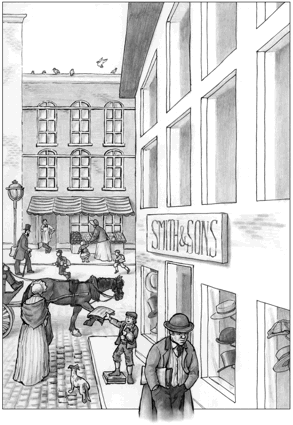
Sure enough, as he dropped his bundle of papers on the curb, just outside Smith & Sons Haberdashery, a gray-and-white pigeon fluttered to a landing, just inches from the toes of Kip’s badly scuffed shoes. Cocking its red eye, the pigeon strutted back and forth, a demanding cuck-coo, cuck-coo in its throat.
“Hey there, Pogo.” A grin spread over Kip’s face, and his blue eyes danced beneath the shock of nearly black hair. Could hardly tell it was the same pigeon he’d found a year ago with a broken wing. “What makes ya think I got somethin’ for ya, eh?” He turned his back on the pigeon, pulled out an armload of papers, and started hawking headlines. “Brits Die in the Crimey! Runaway Slave Kidnapped! Git yer Times here!”
The pigeon began hopping up and down, beating its wings.
Kip turned around. “What ya so mad fer? I’m just teasin’ ya. Here . . .” The boy dug into his pants pocket and drew out the fistful of corn. The pigeon flew on to his coat sleeve and began pecking the corn right out of his hand.
As the pigeon ate, Kip continued to hail passersby. “Git yer New York Times right here! Only a nickel!—Thanks, lady . . . Read about the Crimey War! Right here . . . only a nickel! . . . Top o’ the mornin’ to ya, sir . . . Git yer Times!” The pigeon held on tight to Kip’s coat sleeve as he made his transactions.
Kip had almost sold his first bundle of papers when a tall gentleman stopped. “Good morning, Kip.” The man was still in his twenties and sturdily built, but properly outfitted in long coat, trousers, and derby hat. “Not sure who’s selling more papers this morning—you or that pigeon of yours.” The man’s smile was warm and friendly. “Still got a paper for me?”
“Yes, sir, Rev . . . uh, Reverend Brace, sir.” Kip gave the man his next to last paper and pocketed the nickel. But the man did not hurry on.
“Say, Kip. We’re having some Boys’ Meetings over at the Children’s Aid Society. I’d like you to come tomorrow night.”
Kip looked at the man warily. “Uh, don’ think I can, Rev. Wouldn’t want ter leave my boys—they kinder depend on me, ya know.”
“Bring the boys! The more the merrier! What do you say?”
Kip looked up and down the street, hoping a potential customer was close by to get him off the spot. But the sidewalk was momentarily deserted. He narrowed his eyes and looked back at the friendly face. “Boys’ Meetin’, huh? That just another name fer Sunday school?”
Rev. Charles Brace threw back his head and laughed. Gray eyes twinkled under prominent brows. “Now, come on, Kip. I’m a regular customer of yours. Always come to this corner to buy my paper. The Society would like to help some of the street rovers. It’s a hard life, and you know it. They’re suspicious, just like you. But a lot of the boys look up to you. You’re a leader. If you came to the Boys’ Meeting, they would, too, and that’s the all of it.” Grinning again through his neatly trimmed beard and moustache, the man held out his hand. “So, will you come? Let’s shake on it, man to man.”
* * * *
“You shook on it?” Hooter said, his eyes popping. “What you go doin’ that fer!”
“Yeah. We was wantin’ to play some numbers tomorrow—maybe get us a policy ticket or two.” Smack stuck his lip out, mirroring the faces of Billy and Ned.
“You can do that any ol’ time. Tomorrow night we’re goin’ on over to the Aid Society. They got them a Boys’ Meeting an’ want us to come.” Kip tried to look more confident than he felt. “Come on. You know the Rev. He’s a good ’un.”
“Yeah. I seed him up visitin’ the Conners, the lady what does our wash,” Smack admitted. “That Mrs. Conners, she don’t look so good. But she took the clothes, said she was grateful for the coal.”
“Awright, then. Agreed?”
Reluctantly, the little gang of boys nodded. And true to their word, the next evening they swaggered through the dusky streets, acting like they were going to a fair. Broadway wasn’t far, but by the time they arrived at the Children’s Aid Society, they’d picked up half a dozen more street rovers looking for anything to pass the time.
They arrived noisily to a room already half full of boys of all ages. Kip noticed a rover with red hair who’d once tried to take his corner, but Kip had bloodied his nose and the kid had held a grudge ever since. Kip almost backed out, but just then Rev. Brace slapped him heartily on the back. “Knew I could count on you, Kip. Welcome, welcome, boys. Off with your caps, now . . . just sit down. We’ll be starting soon.”
There was a mad scramble for the benches. One of the other street rovers pushed Billy off the bench he’d claimed, and Billy took it personal. In half a second, the two boys were on the floor, punching each other with abandon. In the other half second, the rest of the room erupted, yelling encouragement to “their boy.”
Rev. Brace and another gentleman pulled the boys off each other and restored a calm of sorts. “Mr. Tracey,” boomed Rev. Brace, a firm hand on the shoulders of the two fighters, “let’s get some gospel songs under their belts.”
The man had a good tenor voice and launched into “Soldiers of Christ, Arise.” He sang by himself for the first few lines, but the words and tune were so compelling that soon many of the boys heartily joined in, though half a step behind since they didn’t know they words. “‘. . . wrestle, and fight, and pray; Tread all the powers of darkness down . . .’”
Then Mr. Tracey opened his big black Bible. “How many of you boys know the story of the Pharisee and the publican?”
Not a hand raised.
“Well, then.” Mr. Tracey cast an anxious eye at Rev. Brace. “Who knows what a ‘publican’ is?”
Kip shot up his hand. “An alderman, sire! What keeps a pothouse.”
Hearty laughter from the boys.
Mr. Tracey’s face reddened. “Alderman! P-pothouse! Wha—?”
Kip glared. What was wrong with what he said? Didn’t the man say “publican”? Had to have something to do with a pub or pothouse. Then he saw that the Rev was trying to stifle a smile behind his hand. Kip grinned. The Rev was all right.
Just then, the redheaded street rover snarled in Kip’s ear, “Think ya smart, doncha, ya little Mick.”
“Who ya callin’ a Mick?” Kip gave the boy a good elbow to the stomach.
In a flash the boy was on top of Kip, tumbling over the benches, and once again the room erupted into a brawl.
Another peace-keeping mission by Brace and Tracey restored the room to order, and Rev. Brace talked to the boys about the Lodging House they were starting for newsboys and other street rovers. Then Rev. Brace brought the Boys’ Meeting to a snappy close. “See you next week, boys. Glad you came, Kip. Good to see you, Hooter. . . .” He shook hands with nearly all the boys as they filed out. Then Kip heard him say as the door closed, “Well. Pretty good start, wouldn’t you say, Tracey?”
* * * *
The next morning Kip was back on his corner, hawking the day’s newspaper, Pogo riding shotgun on his shoulder. “Git yer Monday Times right here! One nickel!” Kip grinned at his customers.
“What a pleasant young man,” murmured an old woman to the policeman who was idly walking his beat. But Kip wasn’t thinking about his customers. He was thinking about the Boys’ Meeting the night before at the Children’s Aid Society. He chuckled to himself. The Rev got a little more than he bargained for!
Pogo walked along the back of Kip’s shabby jacket and took up a beady-eyed watch on his other shoulder.
“Look, Lauren! Look at the pet pigeon!”
“
A little girl about eight ran up to Kip. Behind her a stylish woman in brown wearing a poke bonnet with velvet trim held the hand of a slightly older girl. The two girls wore matching tight-waisted coats and had shoulder-length honey-colored hair. Sisters, probably.
“Nasty pigeon,” sniffed the lady in brown. “Don’t step in its droppings, girls. Ugh.”
Kip ignored the remark. A customer was a customer. “Paper, lady?”
“I suppose—if you’re sure it doesn’t have any bird droppings on it.”
“Oh no, ma’am.” Kip almost wished it did, just to see the lady get upset.
“Can your pigeon do tricks?” The smaller girl cocked her head, imitating the pigeon.
“Sure, missy.” Kip was just about to dig out the last bit of corn from his pocket to show how Pogo ate out of his hand, but out of the corner of his eye he saw a familiar face coming his way—fat, red, and scowling. Kip tried to duck his head. Too late. The greengrocer who “supplied” Kip’s daily breakfast caught his eye.
“You . . . there you are, you little thief! Police! Police! Catch that boy.”
Pogo flapped his wings and darted into the air as Kip dropped his bag of papers at the feet of the two girls and ran.
© 2001 Dave and Neta Jackson