
Chapter 1
The Dare
An overloaded donkey heaved an annoyed eee-aww! eee-aww! in the narrow cobblestone street below the second-floor window, waking Jamal from his dreams. But as soon as the boy popped his eyes open, he heard the familiar call of the muezzin from the tall minaret of the mosque in the square: “Allah is great! There is no God but Allah!”
The morning call to prayer already? Jamal sat bolt upright on the soft rugs and cushions that served as his bed and squinted at his Uncle Samir’s bed in the semi-dark room. Empty.
Jamal groaned and felt around for his trousers and cloth shoes. Why hadn’t he heard Uncle Samir leave for prayer? He had wanted to get up in time to grab a handful of dates and drink some water before the gray fingers of dawn revealed “the difference between a black thread and a white thread”—the traditional way in the Muslim world to tell when another day of fasting had begun during the month of Ramadan. Now there would be nothing to eat or drink until nightfall.
Winding his cloth sash around his already rumbling belly, Jamal hurried out on the balcony that ringed the second floor of rooms above the open courtyard of the Isaam home. The household was quiet. His father, grandfather, and uncle were probably already at the mosque where his father led prayers five times a day. His younger sisters were probably still asleep—still “babies” needing to be cared for by their mother.
Jamal hurried down the steps to the lower courtyard, padded across the cool tiles and through the dark hall to the front door. It wasn’t easy not to eat or drink all day long during Ramadan, but he was twelve now, no longer a child for whom exceptions could be made. Well, he’d just have to tough it out till his family broke the fast at nightfall . . . but all the more reason to play The Game today. It helped distract his mind from his empty stomach.
A smile tugged at
the corners of Jamal’s mouth as he slipped out the door and ran down the narrow
street to the mosque. No one else knew about The Game except his friend Hameem.
It all started a couple weeks back when the two boys, playing along the river
that flowed down the mountain and watered the town of
Jamal snatched up the canteen, looking around to see if anyone had seen him. One of the French soldiers occupying the town must have dropped it.
Hameem’s eyes grew wide as Jamal dipped the canteen in the cold, rushing river, then raised it to his lips to drink. “What are you doing, foolish boy! That belongs to the infidels!”
Jamal, a wiry contrast to the stocky Hameem, shrugged. “It’s mine now.”
“But if they catch you with it, they will think you are a thief!”
Jamal considered.
He knew the rules. French property was French property and should
be returned to the commanding officer. But why should he help the French?
The French didn’t belong in Sefrou—or anywhere in
Jamal decided. “It’s my trophy—the spoil of war!” He held the canteen high.
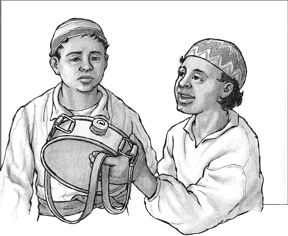
Hameem sneered. “Do you think your uncle will let you bring that into your house? Your mother will make you wash your hands and say ten prayers of penitence.”
That was true, too.
The sultans of
Jamal pulled Hameem down into the scrubby bushes, where they could not be seen by the women washing clothes in the river. His dark eyes shone with an idea. “Hameem! We can pretend we are rebels, fighting alongside the Desert Prince.” Uncle Samir had often held the boys spellbound with stories about the exploits of Abd el-Krim, the notorious rebel leader among the Berber tribes. “It will be a contest—just between you and me—to see who can collect the most things belonging to the enemy.” Jamal looked at Hameem’s dubious face. “I dare you! Here—you can have the canteen to start your collection. Now you’re ahead. But I’m going to win!” . . .
And so The Game had started. Already Jamal had a plastic comb, a leather strap from an officer’s horse, two empty bullet casings, and a metal fork in his treasure box, hidden under the bed pillows in his room. The boys had agreed on a point system: one point for something found; five points for something taken from the buildings the French occupied at the far end of Sefrou; and ten points for something lifted right off a French soldier.
As Jamal slipped into
the big open room of the mosque where his father was leading the morning prayers,
his mind was already plotting how he could add to his collection after school.
But catching the disapproving look in his grandfather’s eye, Jamal quickly washed
his hands for the ritual cleansing, then slipped to
his knees facing the mihrab, the niche in the far wall that pointed the
way to
* * * *
Jamal was afraid he’d be scolded for being late to morning prayer, but his father, grandfather, and uncle were already arguing as the Isaam men headed back to their household—as if morning prayer had interrupted a conversation already in progress.
“Samir, you see a rebellion under every rock in the desert.” Jamal’s father, the imam or leader of prayers in the mosque, waved a hand as though brushing off Samir’s words.
“And you wouldn’t recognize a rebellion if it sat in your courtyard and ate from your dish, Mirsab!” scowled his brother. Uncle Samir was the younger of the two Isaam brothers, but his muscles were big and hard and he walked with a swagger. Jamal had always thought of him as a giant of a man.
“My son, why do you think el-Krim is planning a major attack?” said grandfather Hatim mildly. “We hear rumors all the time. Nothing comes of them.”
“Because of that.” Uncle Samir pointed to a piece of paper tacked to the wall of the corner house on the square. Jamal ran over to look. The face of a French soldier stared from the poster. The writing beneath was in both French and Arabic: “WANTED—for desertion and treason. Sgt. Joseph Klem, 2nd Régiment Étranger d’Infanterie. REWARD.” The poster was dated April, 1925—the European calendar.
“So?” shrugged Jamal’s father. “French soldiers desert all the time.”
Uncle Samir lowered his voice. “But this one has joined forces with Abd el-Krim. He knows weapons—now el-Krim’s forces can be trained to use the machine guns and artillery they took from the Spanish.”
Jamal’s father snorted. “Ha. Not very likely.”
Grandfather Hatim’s
voice was still mild, soothing. “But the last we heard of el-Krim,
he was far to the north in the
“An excellent time in my opinion!” growled Uncle Samir. “We are not distracted by our bellies or women. Don’t say I didn’t—”
“Come, come, no more talk of war and rebellion,” said Grandfather. The men had arrived at the blue door in the whitewashed wall that led into the spacious home within. “We do not want to upset Faheema and the little ones. Mirsab, I will not be back until time for iftar this evening—the French magistrate and I have a full load of cases today. . . . Jamal? Can you be ready in half an hour? I will walk you back to school.”
* * * *
Jamal tried to concentrate as the thin-faced teacher paced back and forth in front of the schoolroom, part of the mosque in the square, chanting that day’s verses from the Koran. “‘This is why when Allah prescribed fasting, he says: “O you who believe! Fasting is prescribed to you as it was prescribed to those before you, that you may learn self restraint.”’”
“‘This is why when Allah prescribed fasting . . .’” the roomful of boys repeated.
“Where is it found?” demanded the teacher.
“Al-Qur’an, 2:184,” said the boys dutifully.
The teacher continued to pace, his brown striped jellaba, the long hooded robe worn by most Muslim men, moving back and forth across Jamal’s vision like a long loaf of bread. Jamal shook his head. He mustn’t think about food.
“Get out your number boards.”
The room erupted in a shuffle as boys pulled clay-covered boards from beneath their benches. Jamal glanced at Hameem. His friend was already at work with a thin wooden stylus, pressing the number problems given by the teacher into the soft clay. Jamal sighed. Why was the morning going so slowly?
The last lesson of the day was French. Jamal groaned silently. Arabic was hard enough. Why did they have to learn to read and write French? The letters and words didn’t even use the same alphabet!
Finally
the call of the muezzin floated through the windows: “Allah is great!
There is no God but Allah!” Time for
Benches were hurriedly moved aside, prayer rugs laid side by side, and the teacher, also an imam, led the boys in the second set of the daily prayers.
Then, like horses released from a starting gate, the boys poured from the schoolroom into the square and galloped eagerly toward freedom. Jamal grabbed Hameem and pulled him down the congested street. “Want to back out?”
Hameem shook his head, and the boys took off running. Since there was no noon meal—the main meal for most Muslim families—during Ramadan, the boys had agreed to scout out the French quarters today to see what they could find to add to their “booty” collections. So far, point-wise, they were neck and neck. It was time to take The Game to a new level.
As usual, the streets were full of merchants selling their wares in the daily suqs or markets, along with jugglers, musicians, and storytellers. Some merchants were shutting down until after mid-afternoon prayers, when business would pick up again. Each street market boasted different goods for sale—baskets in one suq; grains, herbs, and spices in another; bolts of cloth and embroidered clothing in another. Jamal deliberately avoided the market selling fresh food. The smell of couscous and tajins—a savory stew of mutton and vegetables—simmering in their pots could be his undoing. I can wait till nightfall, Jamal muttered to himself.
“Hey!” said Hameem. “Look.”
The boys stopped to check out the small crowd that had gathered around two brown-haired men standing on wooden crates right in the middle of the basket suq. One was wearing a traditional jellaba, but the other had on long trousers and a long-sleeved shirt. Not far away, a middle-aged woman sat in the doorway of an abandoned barbershop passing out picture postcards to a group of boys. She wore a blue caftan like most Moroccan women, but her hair was brown, her face uncovered and pale. Probably American.
Curious, the boys stood on tiptoe at the back of the crowd, trying to hear what was going on. The brown-haired men spoke in careful Arabic, as though the language was unfamiliar.
“Ever since the time of our father Abraham, the prophets in the Old Testament spoke of a Messiah, who would save the people from their sins. Jesus Christ, the Son of God, came to—”
Jamal poked Hameem and snickered behind his hand. He knew most European or American foreigners were Christian—at least they weren’t Muslim. But he’d never heard any of them actually talk about the Christian God.
“Son of God?” challenged a voice in the crowd. “There is only one God, and Allah is his name!”
“You are right, my friend—there is only one God. But God has revealed himself in three persons—the Father, Jesus Christ the Son who lived among us, and the—”
“What nonsense is that?” another man called out. “One God, or three gods? The Koran says that Allah is God and Mohammed is his prophet.”
“The Jews still wait for the Messiah!”
Jamal couldn’t see the last speaker, but he was probably from the mellah, the Jewish section of Sefrou.
The noises of merchants shutting down their shops and the clatter of donkey carts on the cobblestones made it hard to hear what the men were saying. Behind him, Jamal heard the woman’s voice rise and fall, as though telling a story—a common pastime in the marketplace. Losing interest in the men’s argument, Jamal pulled Hameem over to hear what the woman was saying. She was holding a large picture of a bearded man dressed in a jellaba and carrying a lamb on his shoulders. One of the boys dropped his postcard and the wind skittered it against Jamal’s foot. He bent down and picked it up. It was a copy of the same picture.
“The Good Shepherd
looks for His lost sheep until He finds it, just like the shepherds here in
Immediately the crowd parted and made room for the French Legionnaires. The soldiers wore blue caps with black bills and a square of fluttering cloth from the back that covered their necks from the hot Moroccan sun. Marching two abreast, they carried rifles over the left shoulder of their short, blue jackets, and their white pants were tucked into the top of black, shiny boots. A sergeant marked time at the head of the column: “Un, deux, trois, quatre . . . Un, deux, trois, quatre . . .”
The men in the market
stared, then began to murmur among themselves. Jamal
knew what they were thinking. Were these new recruits being assigned to Sefrou? Why? Did that mean the rumors
of a rebellion in the
Jamal absently stuck
the postcard in the folds of his sash just as something bright caught his eye—a
loose button on the jacket of one of the French soldiers marching past him.
It bounced on its threads, shining gold in the
With a sudden movement, Jamal darted close to the soldier, grabbed the button, and pulled. The button came off in his hand.
“Run!” he yelled to Hameem.
© 2002 Dave and Neta Jackson