Chapter 1
Saints and Strangers
Elizabeth Tilley stared in dismay as more men, women, and children cautiously made their way down the narrow ship’s ladder. As if the Mayflower wasn’t crowded enough already! "Move along! Move along!" rasped a sailor’s voice above on the main deck as passengers from the leaking Speedwell were herded below to the tween deck of its sister ship.
"I’ll not go, I tell thee, husband!" A shrill voice from among the ninety passengers already crammed in the tween deck rose above the babble of voices. " ’Twas crowded before; now ’tis like rotten apples crushed in a cider press. Thou canst go to the New World with these fanatical Separatists if thee wants to, but I am getting off this miserable ship."
"Thou wilt do no such thing!" snapped a man.
Thirteen-year-old Elizabeth rolled her eyes, which were green as seawater. It was those Billingtons, quarreling again. For all she cared, they could get off and give the rest of them more room. She, too, was tired of living on board the crowded ship. And they hadn’t even left England yet!
The crew and passengers of the Mayflower and the Speedwell had hoped to leave England in June that year of 1620, but problems in getting supplies and endless arguments over the contract with the Merchant Adventurers, who were financing the voyage, had delayed their departure. In August the two ships had gotten underway, but twice now they’d had to turn back because the Speedwell, the smaller of the two ships, had begun leaking. Finally, abandoned as unseaworthy, the Speedwell’s passengers were being transferred to the larger ship. Now it was September, and they were still anchored in Plymouth Bay, England!
Families—the lucky ones—had been assigned "cabins," each consisting of a sleeping platform about three feet by five feet built against the hull of the ship, separated on each end from other "cabins" by wooden dividers. Hanging a piece of cloth between the dividers provided a little privacy—but, in general, men, women, and children were jumbled together like stew in a pot. Other families, and most of the single men and servants, had to sleep on the deck wherever a few feet of space could be found. And now they had to share even that with the newcomers.
Elizabeth was glad some of the passengers had changed their minds about going on this voyage. Weed out the weak-hearted ones now. But there would be no turning back for the Tilley family. She had overheard her father and Uncle Edward talking on the other side of the curtain last night as she and her mother huddled under their blankets. . . .
"What’s there to go back to, Edward?" her father said quietly. "The silk-weaving business was just barely gettin’ us by. We did the right thing sellin’ off the business and gettin’ out when we did."
"Thy gambling debts didn’t help any," her mother grumbled. Elizabeth sucked in her breath. Her father’s gambling was a sore subject. At first the cock fights and boxing matches at the local tavern had only been a bit of fun with the other men every so often. Then, feeling lucky, her father began betting more money. When he lost, he bet more, hoping to pay off the debts that were piling up. That’s when the nagging and yelling began at home.
"Guard thy tongue, wife, and go to sleep," said her father. "What’s done is done. Make the best of it."
The Tilley brothers lowered their voices even further, and Elizabeth had to strain to hear. "Land—that’s where the real money is, brother," her father went on. "To own land, to be your own master—isn’t that every Englishman’s dream? But is there any land to be had in England? Nay! But in the New World, now, that’s different."
"Perchance, John," said her uncle. "But what dost thou make of these Puritan Separatists? First they run away to Holland; now it’s off to the New World with talk of ‘freedom of religion.’ Why do they want to have a separate church anyway? Think they’re too good for the Church of England, that’s what. Make too much of religion, if thou asks me. The whole lot of them, always singing and praying—even when it’s not the Sabbath! Humph. Maybe we’re asking for trouble throwing in our lot with them. That Brewster fellow, for instance. A printer by trade, but ‘Elder Brewster’ they call him. Hasn’t dared to show his face above deck as long as we’re in England—got a price on his head for some fool tract he printed, I hear."
Elizabeth heard her father chuckle. "Perchance, brother. But the feud between King James and these Puritan Separatists works to our advantage. They’re not welcome in England, so now they’re determined to set up a colony in the New World, where they can worship as they please. But they can’t do it alone—which is why Weston and his Adventurers recruited the likes of us! It’s our chance to make our fortune!"
There was a long silence. Then Elizabeth’s uncle spoke again. "Sometimes I wonder, brother . . . what good will it be to make a fortune? When we are gone, the Tilley name goes to the grave with us."
Elizabeth winced under her blanket. She was the youngest of five children born to John and Joan Tilley. The first two had died of fevers—a wee boy and later a wee girl. The next two sisters survived, but they had been married off as quickly as possible while there was still some money to give them a small dowry. Now Elizabeth was the only one yet at home. She supposed her father loved her well enough, but she knew it was a disappointment to him that he had no son to carry on the family name. And Uncle Edward and Auntie Ann were childless except for her aunt’s orphan cousins she’d taken in to raise—young Henry Samson, who was ten, and eight-year-old Humility Cooper. But she’d show her father. He wouldn’t regret taking her to the New World. Son or no, she’d help him make his fortune in the—
"Oh, Cousin Eliza!" Humility’s childish voice broke into Elizabeth’s thoughts. "Come and see the doggies!" The little girl’s brown eyes were dancing under her coif, a white cap that was used to tuck up the hair of all women and girls in seventeenth century England. Elizabeth’s own mop of red curls was tucked up into her coif, though the unruly curls had a way of escaping from under the cap no matter how many pins she used. "Truly!" Humility bubbled on. "One is almost as big as a pony! And a dear, sweet spaniel, white with brown spots."
"Do come on," hissed Henry in a whisper, "before Auntie Ann gives us more tasks to do."
Elizabeth longed to escape the jostling bodies and stifling air in the tween deck as everyone made room for the new passengers. Maybe she could find Mary Chilton, the one friend she’d made so far on board ship. But one look at her mother’s flustered face and she shook her head. "Perchance later, Humility. We must make up the bedding for Mam and Auntie Ann. Henry, help me move these coals before someone tips the brazier over and we set the whole ship on fire."
The small iron brazier sitting in its box of sand served as the only means to cook their food on board ship. As the cousins carefully moved the smoking pan of coals out of the way of clomping shoes and long skirts pushing past, Elizabeth heard a timid voice say, "Beg pardon, Goodwife."
Looking up, Elizabeth saw a slender young woman wearing a maroon-colored cape, her dark hair peeking from under her coif, and looking quite lost. Elizabeth had seen her many times on the docks at Southampton and Dartmouth as the passengers from the two sister ships had mingled and waited, waited and mingled. She was the wife of one of the Separatist leaders, though she hardly looked older than a girl herself. Now she was trying to speak to Elizabeth’s mother, who was rearranging bundles under the sleeping platform. "Could I . . . I mean, wouldst thou mind—" The woman stopped helplessly.
"Eh?" Joan Tilley straightened up, all a-fluster. "Oh! Good day, Mistress Bradford. Would thou be looking for a place to set thy bundles, then?" The young woman nodded gratefully. Joan Tilley cocked a curious eyebrow. "And where is thy husband, Mistress Bradford? Tsk, tsk—leaving thee to settle aboard all by thyself. The way of men, aye?"
The young Mistress Bradford managed a pale smile. "He’s above, talking to Master Weston—"
"Marry! Still arguing about the contract!" said Joan Tilley. "Well, I hope he gives that weasel a piece of his mind. Never met the like! Says one thing today, something different tomorrow. Well, now," she said, looking around, "surely we can find thee a wee spot of room to put thy bundles."
Grabbing Humility and Henry by the hand, Elizabeth scrambled up the ladder to the main deck. Huh! she thought. That woman looks like a pampered china doll. Taking her on a dangerous sea voyage is like turning a butterfly loose in a thunderstorm.
An argument was in full swing on the main deck. "These terms are outrageous, Master Weston!" an older man in a white lace collar, dark green doublet, and well-cut breeches said. Elizabeth had heard the Separatists call him Master Carver—a wealthy man by all appearances. The Carvers had no children but several servants. "Not even two days to work for ourselves?" Carver fumed. "And all to be divided—even houses and fields—at the end of seven years?"
The man named Weston shrugged. A twist of gold-colored cloth ringed his felt hat, and gold garters held up yellow stockings. Elizabeth recognized him as the man who had recruited her father for this voyage to the New World. As Elizabeth and her cousins squeezed past, she heard the man say firmly, "Those are my terms, gentlemen. My stockholders must gain interest on their investment."
"Interest!" exploded Carver. "This is robbery!"
A calm voice intervened. "Thy people are investing mere money, Master Weston; our people are investing their very lives in this undertaking. Who knows what awaits us in the new land?" The speaker was nearly six feet tall, maybe thirty years old, a handsome man, bearded, with a firm jaw and serious gray eyes. Master Bradford, Elizabeth thought, the china doll’s husband. "But," Bradford continued, "we have no choice but to accept thy terms. We must sail with the tide. Good day, Weston."
Weston merely shrugged and with a sly smile climbed over the side of the ship to the longboat below, which would take him back to the dock.
"Come on, Eliza!" wailed Humilty, pulling on Elizabeth’s sleeve.
Elizabeth allowed herself to be dragged across the narrow deck to the main mast, where a young man with a shock of sandy brown hair—she guessed him to be twenty-one or twenty-two—was holding two dogs, a huge mastiff and an English spaniel, by their leather leashes. Young Henry was tussling with the spaniel and getting his face licked in return.
"Thy dogs?" Elizabeth asked politely.
The young man’s face turned red. "Nay, miss. They belong to John Goodman. He asked me to hold them while he said good-bye to his new wife." He seemed to be staring at Elizabeth’s freckled face.
Her manner cooled. "And thou art—?"
"John Howland, miss. Bond servant to Master Carver. Like a father he’s been." The color in the young man’s face deepened, as if he had blurted out too much.
"Oh, Eliza!" Humility giggled as she wrapped her arms around the huge, brindle-colored mastiff. "This one’s name is Bear!" Elizabeth turned away, trying to look bored. She wished Humility wouldn’t call her Eliza. The young man was just a servant, after all.
"There you are!" Mary Chilton, who was fifteen, pulled Elizabeth around to the other side of the main mast, which stood like a massive tree trunk in the middle of a forest of ship’s rigging and furled sails. "Must thou always be tied to those silly cousins of thine?" she asked in mock horror. "And gossiping with the servants, too!"
Elizabeth started to protest, but Mary babbled right on. "We’re sailing today in truth. Look!" She pointed to a short, pompous man with a dark reddish beard, wearing a helmet and sword, who was helping a weeping young woman climb down the rope ladder into a longboat below. "I heard the ship’s master tell Captain Standish to get all visitors off the ship—the tide is about to turn."
" ‘Captain Shrimp,’ thou means," Elizabeth smirked.
Mary’s eyes widened. "Nay! Who calls him that? Not his sweet wife, Rose!" But Mary, too, started to laugh behind her hand.
"The sailors. They were making fun of him when he was drilling the men on deck." Everyone knew that the dashing Captain Myles Standish had been recruited by Master Weston to form a militia to protect the new colony. Elizabeth grinned impishly.
The girls’ giggles were interrupted as the first mate began shouting orders from the quarterdeck. Suddenly, the top decks became an anthill of activity as sailors started climbing the rigging to loosen the sails and others began turning the windlass, which pulled up the anchor. "Oot the way, lassies!" beckoned Captain Standish, rattling the sword at his side impatiently. His Scottish accent was crisp and demanding. "Get the children and thyselves below!"
G G G G
They sailed with the tide. Twenty passengers from the Speedwell had decided to stay behind, leaving 102 on board the Mayflower. Forty-one were Puritan Separatists, or "Brethren," as they called themselves. The majority were ordinary Englishmen, loyal subjects of King James and members by birth of the Church of England. They would have been surprised to know that the Brethren referred to them kindly as "Strangers." Not so kindly, some of the sailors sneered at the Separatists and called them "Saints" as if it were a dirty word.
Once the Mayflower had cleared Plymouth Harbor, the ship caught a fair breeze under full sail. Cleared earlier from the deck out of the sailors’ way, both Saints and Strangers now began to drift back to the main deck for one last look at their homeland. The sun was sinking before the ship’s bow in the west, reflecting off the windows of Plymouth behind them like fiery rubies in an emerald necklace.
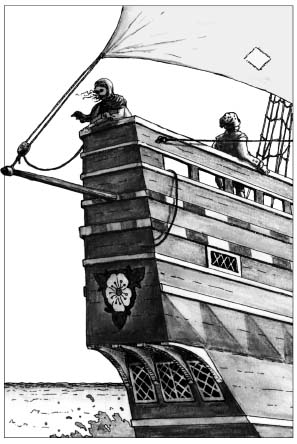
Escaping her young foster cousins, Elizabeth climbed up the ladder to the quarterdeck and made her way toward the rear of the ship for a better view. She felt a sudden sadness at leaving all she’d ever known. She wasn’t close to her married sisters . . . but would she ever see them again? At the same time she felt a flutter of excitement. Father was right. There was nothing left for them here in England. But a new land, a new home—there they could get a new start. There she would discover her place.
Elizabeth’s thoughts were interrupted by two voices behind her on the other side of the mizzenmast. "Oh, William, did we have to leave him behind?" a woman’s voice moaned as if in pain.
"Dority, Dority," soothed a man’s voice. "Don’t do this to thyself. Thou knows why we left him with Pastor Robinson. A sea voyage late in the year, an untamed land—thou knows the dangers. But as soon as we build homes in the wilderness and find a way to keep ourselves alive, we will send for wee John."
Elizabeth could hear muffled sobs. She inched farther along the rail, trying to see who was crying.
"But," the woman sniffed, "the Whites brought their son, Resolved, and he’s five, same as John. Wrestling Brewster is only four. And wee Mary Allerton is a mere sucking child! Oh, William, if other parents could bring their children—" The sobs grew louder.
"Dority, stop. Thou wilt make thyself sick. We made the best decision we knew how. Others also left children behind. Come, come, now, dry thy tears. God will give us the strength to endure." The couple slowly moved out of the shadows and made their way toward the ladder. The woman was almost hidden by her husband’s arm and long cape wrapped around her. But Elizabeth recognized them immediately.
Dorothy, the china doll wife, and William Bradford.
© 1998 Dave and Neta Jackson