Chapter 1
Wild Woman
Squatting on the open porch of the little bamboo house on the outskirts of the city of Rangoon, Len-Lay didn’t see the shadowy figure crouching in the dark below. The house, like many in the country of Burma in 1823, stood off the ground on four-foot-high stilts. Pigs grunted contentedly underneath; scrawny chickens had ceased their endless pecking as night fell and were roosting among the stilts.
The dark-haired girl hummed softly as she stirred vegetables into a bubbling pot of chicken stew. She felt very grown-up as she checked the hot coals in the container beneath the pot; the embers were glowing brightly. The twelve-year-old rocked back on her heels smugly. Ever since her mother had gone away the previous year, Len-Lay had been doing all the cooking and cleaning—with Mah-Lo’s help, of course.
Len-Lay wondered about her younger sister . . . Mah-Lo should have been back with the waterpot by now. If she didn’t come back soon, the broth would boil away and the stew would burn. Len-Lay squinted impatiently into the smoky dusk of the December evening.
Then she spotted her. A small figure tottered unsteadily between the crowded row of stilt-houses, balancing a waterpot on her shoulder. Len-Lay hopped to her feet, snatched up a bowl of steamed rice, and hurried inside. "Aphe! Father!" she called, setting the rice on the eating mat spread in the center of the room. "Mah-Lo’s coming. We can eat—"
The sound of a terrified scream tore through the quiet house.
Maung Shway-Bay, writing a letter by candlelight in a corner of the room, leaped to his feet and knocked over the stool that held his inkpot. "Mah-Lo!" he cried, rushing past his oldest daughter and out onto the porch. Len-Lay, her heart pounding, cautiously followed and peered around her father’s broad back.
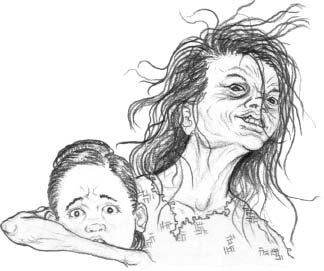
Ten-year-old Mah-Lo was writhing in the grip of a wild-looking creature and screaming at the top of her lungs. The waterpot had fallen and its contents spilled. The woman—was it a woman?—clasped the girl with long, bony arms; her hair stood out in all directions, framing large, fierce eyes. Worst of all, the wild woman was laughing, a high-pitched cackle that made little bumps rise on Len-Lay’s skin.
Maung Shway-Bay gripped the bamboo porch railing in shocked silence. Why was her father frozen in place? Why didn’t he do something?
Then Len-Lay heard him gasp. "Mah Kyi!"
Her mother? Could it possibly be—
"Yesss! Mah Kyi has come back!" the woman hissed as if answering Len-Lay’s thoughts.
Mah-Lo stopped screaming, twisted in the woman’s grasp, and stared into the wild eyes just inches from her face.
"Let the child go, Mah Kyi," ordered Maung Shway-Bay, starting down from the porch.
"Stand back!" the woman screeched. Her husband stopped. That’s when Len-Lay realized that neighbors had gathered in the road when they heard the screaming. Maung Shway-Bay held up his hand, signaling them to stay back.
He took a deep breath. "What do you want, Mah Kyi? Why have you come back?"
"Why? Why?" Her eyes grew larger and more fierce. "For my children, of course. I am their mother. I have come to take them with me!"
Len-Lay gasped and ran to her father’s side.
Maung Shway-Bay’s voice trembled a little. "You are sick, Mah Kyi. You cannot take the children. You must go away and rest."
"Sick?" Mah Kyi challenged. "Look how strong I am!" She tightened her arms and lifted Mah-Lo off the ground. The frightened child started to wail loudly and struggle again.
"Let the child go, Mah Kyi! You are frightening her. A mother does not frighten her own children."
Mah Kyi lowered Mah-Lo to the ground. The girl sobbed in the woman’s strong grip.
"You are the sick one!" The woman pointed a shaking finger at her husband. "You associate with foreign spies! You listen to their strange God-talk. You have disturbed the karma of this house! I will take the girls away, before they go crazy, too!"
Len-Lay’s thoughts were swirling. What was her mother talking about? What spies? Did she mean Mr. Judson, the white man who lived in the mission house? Her father did spend a lot of time there studying and talking, and a few years before he had done a strange thing: He let the white man put him under the water of the Irrawaddy River. The missionary called it being baptized, and her father said it meant that now he was a Jesus follower. But . . . that was supposed to be a secret. All Burmese people must worship Buddha. It was the law.
"Len-Lay." Her father leaned close to her ear. "Run to your mother’s brother. Tell him Mah Kyi has returned. He must come quickly and get her before she harms Mah-Lo—or herself."
Len-Lay gulped. Her uncle’s house was three miles outside Rangoon, in a little village to the west. But she obediently scurried down the porch steps.
"Catch her! Catch her!" screeched her mother. "Don’t let her get away!"
But the little crowd that stood uncertainly in front of Maung Shway-Bay’s house parted and let her slip into the night.
G G G G
It was morning before Len-Lay finally returned home.
All the way to her uncle’s village, she had tried not to think of the tigers that sometimes came out of the forests at night. But the tiny hairs on her neck stood up whenever unseen monkeys shrieked from the tops of the tamarind trees. On and on she hurried until finally the thatched, bamboo houses of her uncle’s village took shape in the darkness.
Her mother’s brother had listened with a frown as Len-Lay gasped out her story, then without a word headed back down the road toward Rangoon. "Stay here for the night, child," her aunt soothed. "You can return in the morning when it is safe."
Now Len-Lay walked uncertainly into the little fenced-in yard and up the porch steps of her house. She noticed the pot of chicken stew was still on the little stove. All the broth had boiled away and the chicken and vegetables were stuck, hard and cold, on the bottom.
Then she heard her uncle’s voice, harsh and accusing.
"Yes, my unfortunate sister is crazy in the head; we will take her away again. But she is right about one thing, Maung Shway-Bay, you associate with false people! You keep a false religion, and you speak false words. What is worse for your children—a crazy mother, or a father who denies his own religion?"
At that moment Maung Shway-Bay saw Len-Lay in the doorway and motioned for her to come in. She soundlessly crossed the bamboo floor and sat next to Mah-Lo, who was half-hidden behind her father.
With a quick glance around the room, Len-Lay saw her mother crumpled passively in the corner, asleep. Her father sat on a stool facing his brother-in-law, hands on his knees.
Len-Lay’s uncle sucked in a deep breath. "Rumors are going around the city that the English are preparing to attack Rangoon from the sea. People are also saying that the white people, the so-called missionaries, are really spies who give away our military secrets."
Maung Shway-Bay laughed aloud. "Ridiculous!" he snorted. "They are teachers of Christianity—"
"The religion of the English."
"Maybe so. But the missionaries are from America, not England."
Len-Lay’s uncle shook his head as he considered this fact. "Nevertheless," he spat out, "only evil can come from your association with them. As your brother-in-law, I would be within my rights to beat you, to pound out this evil from our family. Consider what I say!"
The uncle then rose abruptly, went over to the corner and shook the woman awake. "Come, sister. We must go."
Mah Kyi opened her eyes and looked around in confusion, as if she didn’t know where she was. She looked at Len-Lay and Mah-Lo showing no sign of recognition, then meekly allowed her brother to lead her out of the house.
Len-Lay stood with her father and Mah-Lo in the doorway and watched them go. Suddenly Len-Lay buried her face against her father’s side. The words of the two men frightened her. Was her father in danger? Would her uncle really beat him?
Len-Lay sank to the floor of the porch and hugged her knees. She was shaking all over. Everything was wrong! When her mother first started acting strange and had to go away, Len-Lay had cried herself to sleep every night. Gradually, she had gotten used to her mother’s absence . . . and now she had shown up again, so different, so . . . so terrible.
Len-Lay felt as if she were being torn in two. She wanted her mother back—the pretty, laughing mother who had combed Len-Lay’s long, dark hair as a little girl and taught her how to coil it on top of her head. Len-Lay had loved to wear pretty combs and flowers in her hair in an effort to look like her mother.
But this woman—this wild, cackling woman—how could she be her mother? Len-Lay shuddered. She had been so frightened watching Mah-Lo struggle in Mah Kyi’s fierce grip. She was relieved she was gone!
Len-Lay beat her small fists against her knees. Gone! Gone! Gone! Then hot tears poured down her cheeks. "Oh, mother . . . my poor mother," she moaned.
After a long time, Len-Lay felt her father’s hand on her shoulder. "Eldest daughter, you must dry your tears and help your sister pack. It is no longer safe here. We must go to the mission house."
G G G G
The two Burmese girls stood on either side of their father in the mission yard, each holding a bundle of clothing. Len-Lay wore a blue silk longyi—a long skirt wound about her body—with a short white tunic. Gold bracelets, necklaces, and anklets made her nut-brown skin glow.
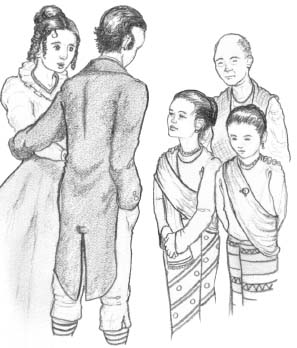
Mah-Lo was similarly dressed in a lemon yellow longyi. They nervously gripped their father’s patso, the loose flowing trousers he created by knotting a piece of bright-colored silk around his waist and legs.
The girls stared at the strange man and woman who came to meet them. Though they had both been to the mission house before, they had never gotten used to the pale skin of Adoniram and Ann Judson. He wore a funny black jacket and black trousers; she wore a white blouse with long sleeves and lace at her throat; her heavy skirt was a dull brown.
Mah-Lo giggled and Len-Lay knew what she was thinking. Didn’t these foreigners like pretty colors?
"Quiet!" their father hissed. Then Maung Shway-Bay spoke to the missionaries.
"Teacher, I come to ask a favor. My unfortunate wife is sick in her mind, and I had to send her away. Also, my brother-in-law—and even my own brother—has threatened to beat me because I now follow Jesus. I beg you, take my girls into your house. Teach them to read so they can read Jesus’ words on the paper you have written."
Adoniram Judson’s smile turned to deep concern and he looked at his wife. Then he pointed toward a pile of crates and boxes that stood in the mission yard. "Dear brother, we are leaving Rangoon," he said in Burmese. "We sail tomorrow for Ava, the Golden City, to build a second mission house there. I have only been waiting for Mrs. Judson to return from America. Surely, you don’t want us to take your children so far—"
Len-Lay shivered with fear and excitement. Leave Rangoon? No, no! She did not want to go so far away from her father. But Ava, home of the emperor, lord of all air and water . . . she never dreamed she might travel so far!
For a moment Maung Shway-Bay looked confused. Then his face became resolute once more. "Yes. I will let them go. Take my motherless daughters into your home under your protection. Teach them to read."
For a moment no one spoke. Nervously Len-lay looked around. She noticed a strange chair sitting among the packing boxes. It had two curved pieces of wood stuck to the bottom of the legs. She thought that if someone sat in it, it would surely tip right over!
Then she heard Mrs. Judson say, "Adoniram, if Maung Shway-Bay’s girls went with us, I could begin my school for girls in Ava right away."
"But, Ann!" her husband protested. "You have just returned from a long voyage; you have only recently recovered your health after a long illness. Are you sure you are up to mothering two half-grown children?"
Mrs. Judson’s eyes shone with unshed tears, but her voice never wavered. "God saw fit to take our baby, Roger. My arms have been empty. Now it seems God will fill them with these dear girls."
Mr. Judson tenderly brushed a strand of hair from his wife’s face. "Well, then," he said, turning back to Maung Shway-Bay, "it is settled."
© 1993 Dave and Neta Jackson