Chapter 1
Red Caps in the Mist
"Chuma! Chuma!"
The urgent call cut through the morning mists that floated along the shore of Lake Shirwa. Why is Wikatani yelling at me again? wondered Chuma. He thought the older boy bossed him around too much, especially so early in the morning. What was the hurry this time? They would get the village sheep to the pasture soon enough, well before the African sun rose high enough to drink the dew drops off the tender blades of grass.
"Chuma, help. . . !" And then Wikatani’s voice was choked off as though he were gagging on a ball of wool. Chuma swung his staff at the heels of the last lazy sheep. The sheep leaped ahead to catch up with the flock that stretched around the bend of the lake shore and disappeared into the mist. Wikatani is always in a hurry, Chuma thought. What difference does it make whether the sheep eat along the trail or in the pasture? Still, he couldn’t remember Wikatani’s voice ever sounding so urgent.
Instead of trying to push his way through the flock of sheep, Chuma ran out into the shallows of the lake to get around the woolly animals. The cool water splashed high over his body with each step until he hit a hole and suddenly sunk in water up to his neck. Chuma was a good swimmer, and there was no danger, but he grabbed quickly at the folds of his clothes to make sure the yam he had hidden there for lunch was still safe. He also checked to see that his drinking gourd still hung from the cord around his neck.
He swam strongly until his feet touched bottom again, and he waded to shore. With a brief scramble that dislodged sand and gravel, he made it to the top of the bank and plowed through the tall grass to a point where he could again meet the trail. He paused to scan the trail and listen for Wikatani. Straight ahead of him, through the fog he thought he could make out his friend, but who were the strange men, and what was wrong?
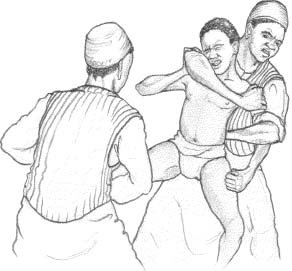
Wikatani looked as if he were fighting for his life! One man held him securely from behind while another man tried to bind the boy’s feet with cords. Frightened, Chuma barely held back a scream. What should he do? Should he rush to the attackers and try to free his friend or hold back until he figured out what was happening? Just then Wikatani must have bitten the hand of the man who held him because the man yelped, and Wikatani began yelling again: "Chuma! Chuma! Run for help!" Quickly the man clamped his hand back over Wikatani’s mouth and looked at Chuma.
Chuma stared in disbelief and shock as the stranger’s fierce eyes locked on him, but only for a moment. Chuma spun around to run back down the lake shore to their village—but he was not fast enough. A third man who had hidden in the tall grass jumped out and faced him with a spear pointed right at his heart. Chuma froze in his tracks before he noticed that the man’s spear had no point and looked more like a sawed-off canoe paddle with the handle pointed toward him.
Chuma thought of diving into the lake; not many people could outswim him. But before he could move, the man poked him hard in the chest with the pointless spear. It did not cut, but pain shot through his bones. Chuma decided not to make a run for it. Then the man began speaking to him in a strange language and motioning with his pointless spear. Chuma understood that he was being ordered to join Wikatani and the two strangers, so he turned and slowly walked through the deep grass to the trail.
When Wikatani saw that Chuma had been captured, the older boy’s shoulders sagged. One of the men quickly tied Chuma’s feet and then left both boys sitting helplessly on the ground by the trail while the men spoke to each other in their strange language.
Swallowing his fear, Chuma studied the features of the unusual looking men. He had never seen anyone who wore bright red caps or pants or vests. He knew they weren’t from his tribe, the Ajawa. And they didn’t look like Manganja tribesmen either. Even though the Ajawa tribe had sometimes feuded with the Manganja, they were the only two tribes in the area. The Ajawa villages were primarily situated around Lake Shirwa, while most of the Manganja villages were to the west, near Mount Zomba. So who were they?
One of the men near Wikatani stood up and raised his pointless spear to his shoulder. He pointed it toward one of the sheep that was grazing along the trail. Suddenly the pointless spear made a terrible boom, and white smoke shot out of the end. Both boys cried out with the thunder, then opened their eyes. There lay one of their sheep—dead!—while the others ran off. That was bad. The village elders would be angry at the boys for having lost a sheep, but what if the strangers stole or killed the whole herd? Fear gripped Chuma’s stomach.
And what about the stranger’s awesome weapon? To Chuma, it looked like the pointless spear had killed the sheep without the stranger having thrown it. "Very powerful magic," Chuma whispered to Wikatani.
"They are guns. I have heard of them," said Wikatani. "They can kill from far away."
"Of course . . . guns," said Chuma. He did not like to admit it when Wikatani knew something he did not know, even though Wikatani was thirteen and he was only twelve years old.
Then Chuma was surprised to notice the man pick up a regular spear. He could see by its tribal markings that it was a Manganja spear. The man walked over to the dead sheep and wiped some of the sheep’s blood on the spear. He broke the spear over his knee and brought the pieces back and threw them on the ground near Chuma and Wikatani. Then he ordered one of the other men to pick up the dead sheep and carry it over, too.
Seeing the other man obey his order convinced Chuma that this man was the leader of the group, maybe even a chief, though they were all dressed the same.
When the other man brought the sheep back, he let some of the blood drip on the sand and grass around the area where the boys were bound. Chuma did not understand these strange actions, but it was getting scarier by the moment. Were they performing some kind of magic?
Next, the leader grabbed the drinking gourd that hung by a thong from Chuma’s neck. With one jerk he broke the thong and then smashed the gourd on the ground. Chuma stuck his chin out at the man defiantly. He could make another drinking gourd. He only carried the gourd with its fresh water because it was convenient when he was watching the sheep on the hills around Lake Shirwa.
But the man also ripped the family bracelets from Wikatani’s arms and threw them to the ground not far from the broken gourd. He gave more orders. One man tied Chuma’s hands behind his back while the other tied Wikatani’s behind his back, and then they cut the cords on their legs.
Finally, the leader of the Red Caps started up the trail while the other two men prodded Chuma and Wikatani to follow. Now what’s happening? thought Chuma with alarm. They are not stealing our sheep; they are taking us!
One of the men carried the dead sheep over his shoulder. It was still dripping blood on the trail as they walked. In a short distance, they turned off the main trail along the lake shore and marched west, away from the lake. The path was barely visible as it wound uphill through the thick grass toward the jungle.
Chuma looked back anxiously. The mist was lifting from the lake, and before they entered the jungle he could see its peaceful surface shining in the morning sun. Far back along the shore were wisps of smoke rising from their village.
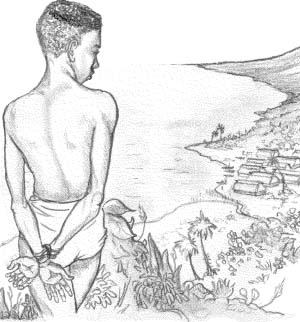
That was home, and they were being taken away. No one will know where we are! worried Chuma. They won’t even miss us until tonight when we don’t return with the sheep. By then we’ll be so far away that they will never find us! Below, their sheep were wandering away from the trail along the lake front. Suddenly a hopeful thought came to him: Maybe some sheep will wander home. Someone will certainly notice and know something is wrong and come looking for us. Or else, and his spirits fell, or else they’ll just think we’ve been careless.
As they entered the jungle, Chuma could no longer see the lake. The dew that had clung to the grass of the open fields now dripped like rain from the trees and vines overhead. Monkeys screeched and swung from limb to limb as the boys and their captors passed beneath. As the Red Caps hurried the boys along under the dark trees, Wikatani said in a hushed voice, "They had a Manganja spear. Do you think they are from the Manganja tribe?"
"I don’t think so," answered Chuma. "Why would the Manganja take us away?"
"They’re our tribe’s old enemies."
"Yes," said Chuma, "but it is a disgrace to send others to fight your battles. These aren’t Manganja, and we are only boys. What could be gained by capturing us?"
"Well, I am a chief’s son," said Wikatani, lifting his head proudly. "Much trouble will come from attacking me. We are headed west into Manganja country. The Manganja must be behind this, and they will pay!"
"But the Manganja have no reason to attack us," said Chuma again.
At that point a Red Cap slapped Chuma on the back of the head so hard that he stumbled and fell. With his hands tied behind his back, he was unable to catch himself, and his face plowed into the dirt. Fortunately the ground was soft, and Chuma was not hurt. He quickly got up spitting bits of leaves and dirt from his mouth.
"No talking! Just march," shouted the Red Cap angrily, gesturing, and raising his hand as though to strike again. Chuma was as surprised that this man could speak their language as having been hit on the back of the head. What’d I do? What’s so wrong with talking? Chuma wondered.
Wikatani said, "Don’t hit him. He didn’t do anything."
"I said, ‘No talking,’" yelled the Red Cap again, this time at Wikatani. He spoke the boys’ language well enough for them to understand him, but his accent was very thick. Then the Red Cap swung his gun at Wikatani like a club. Wikatani dodged out of the man’s reach and hurried on up the trail. Chuma followed as quickly as he could.
By noon Chuma was feeling hungry and thirsty. Safely tucked in the folds of his loincloth was the small, cooked yam that his mother had set aside for him to eat while he herded sheep. He longed to take it out and eat it, but his hands were tied. Besides, he was afraid that the Red Caps would throw it away as they had his drinking gourd.
Plodding along the jungle trail, Chuma’s thoughts kept returning to the house with its sturdy mud walls and thatched roof where he lived with his father and mother and three little sisters. He wanted to be brave, to face this difficulty like a man, like his father . . . but he kept thinking of his mother. Who’ll fix my food? he wondered, even though he knew that wasn’t his worst problem at the moment.
© 1992 Dave and Neta Jackson