
Chapter 1
Party at the Big House
Robbie knew something was wrong when he saw his older sister, Margo, sitting on the stoop in the twilight holding baby Mae, her face streaked with tears. Sissy and Tommy, who were five and seven, crowded close to her skirts.
"Is it…Papa?" Robbie asked, his mouth dry.
Ten-year-old Robbie had been out all day, taking old Mrs. Dobble’s brown cow to graze along the road. When he brought the cow back at dusk, the toothless old lady had paid him with a tin of milk—fresh, warm milk for baby Mae and Sissy and Tommy. He had imagined how pleased Mama would be—but now the pail hung from his hand, forgotten.
Margo nodded wordlessly. Then Robbie heard it: the sound of their father inside the shabby cottage retching again and again—those horrible dry heaves, with nothing coming up—and then a long groan.
Margo, who was fourteen, buried her face in baby Mae’s cotton gown, while Sissy stuck her thumb in her mouth and Tommy looked ready to cry. Their father was sick—had been ever since he and Peter had come home from London two nights ago. Thomas Robinson was a "carter"—hiring himself and his mule cart out to do hauling jobs—but work was hard to find around the little village of Wellow. So the first week of June that summer of 1852, he and sixteen-year-old Peter had harnessed Cinder the mule and gone to London to find work.
They’d been gone three weeks. "No news is good news," Sally Robinson had said each day. "Maybe they found work and can’t get away." But each evening she had stood in the doorway and, shielding her eyes from the low-hanging sun, looked down the road, hoping to see her men coming home.
Then, two nights ago, they’d seen the mule and cart coming. But as it came closer they could only see Peter sitting on the narrow driver’s seat of the four-wheeled cart. Where was Papa? But as Cinder turned into the narrow dirt driveway which went around the little cottage to the mule shed in the rear, they saw Thomas half sitting, half lying in the cart box.
Mama and Peter had helped Papa into the house and put him to bed. Peter said he and Papa had found work carting away rubble from a warehouse that had burned down. But the pub where they found lodging was crowded and foul smelling, and many people were getting sick with vomiting and diarrhea. And then Papa…
That was two days ago, and now Papa was worse. Robbie handed the pail of milk to Margo and crept quietly into the cottage. Papa was groaning on the bed half hidden behind a quilt hung for a curtain. Mama barely glanced up from wringing out a damp cloth and trying to moisten his dry lips.
"Robbie! Run up to the Embley estate and ask the young Miss Nightingale to come," she said.
Robbie swallowed. He’d never been up to the fancy house by himself before. "Why can’t Peter—?"
"Peter took Cinder out looking for work—at least that’s where he’s supposed to be!" Sally Robinson snapped. "Get along now—Papa needs help fast."
Robbie ran out the door, past the weepy knot of his three sisters and little brother outside their thatch-roofed cottage, and took off down the road toward Embley. The Robinsons lived on the edge of the vast Nightingale estate, and sometimes Papa did jobs there, like when they added that big wing with more bedrooms for guests and a large hall for parties. Peter had a way with horses, so every now and then he helped out the stable man there. But the Nightingales only lived at Embley half the year. The muggy summer months were spent up north at Lea Hurst, their summer home.
As Robbie’s feet pounded the hard-packed dirt, he realized he hadn’t had any supper. His stomach pinched with hunger. But there would be no supper until he brought Miss Nightingale back with him.
As the wiry boy approached the main gate of the Embley driveway, he saw the curving drive was filled with carriages and teams of sleek, matched pairs of horses. Grooms leaned against their masters’ carriages, smoking pipes or polishing the brass lamps. More carriages were arriving and pulling up to the front door, letting out laughing ladies in swishing gowns accompanied by gentlemen in tall hats. The great house was alight, each window sparkling with candelabras and chandeliers.
Robbie stopped short. He couldn’t go up to the door. There was a big party going on! He turned to go—then hesitated. He couldn’t go home, either. Papa was sick—maybe even dying. He had to get help.
Pushing down his misgivings, Robbie quickly slipped through the wide-open gate, skirted the carriages on the driveway, and headed for the back door. He could hear music and laughter inside the house. Climbing the steps up to the kitchen door, he knocked. He had to knock loudly several times before the door finally opened. At the last minute Robbie pulled his cap off his head.
A young maid—maybe Peter’s age—looked at him quizzically. "What do you want?" she asked.
"P-please, Miss, I need t-to speak to Miss Nightingale—Miss Florence," Robbie stammered.
"Huh! I don’ think you’ll do any such thing tonight," the girl said. "There’s fancy goings-on."
"I know, but—"
"Why’s that door open?" hollered a sharp voice from inside the kitchen. A huge form wearing a lopsided, puffy, white cook’s hat appeared beside the girl.
"Someone to see Miss Florence," the girl smirked.
"What? Go away, boy. Miss Florence don’ have time for the likes of you tonight. Shoo, shoo! Go on, now!" The door swung shut, but not before Robbie heard the cook mutter, "Miss Flo do a good turn for the riff-raff ’round here, and the next thing you know they’re walking right up knocking on the door." Slam.
Robbie jammed his cap back on his head. Now what was he supposed to do? He made his way back along the side of the large house. As he came abreast of the veranda, he saw another carriage pull up to the wide steps and a handsome couple get out. The front door of the big house was wide open in the warm June evening. A butler took the man’s hat and walking stick, while a lovely young woman in a green silk gown greeted her guests.
"Oh, Flo, you look divine tonight!" giggled the lady guest before she swept inside.
Robbie’s eyes widened. Miss Florence herself was on the veranda—this was his chance!
Without thinking of the consequences, Robbie dashed around the bushes and up the smooth, stone steps. "Miss Florence!" he panted, tugging on her skirt. "Please come quickly—it’s my father! He’s sick and—"
The butler turned, thunder in his eyes. "You, boy! Go away before I throw you down the steps!" The butler’s hand grabbed Robbie by the collar.
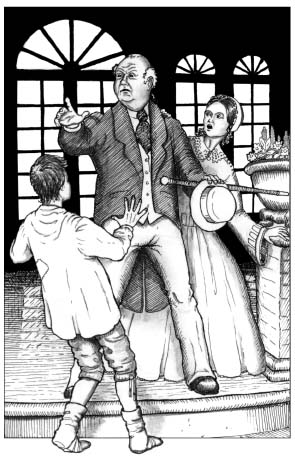
"No, wait—it’s all right," said the young woman’s calm voice. Miss Nightingale bent slightly and peered into Robbie’s face. He caught a whiff of rose perfume. "You are—?" she asked.
"Robbie Robinson, miss," he gulped, remembering to snatch the cap off his head once more. "It’s Papa—he’s bad sick, and Mama sent me to fetch you. That is, if you’ll come."
Florence Nightingale straightened. "Of course I’ll come. I know your family. Your mother wouldn’t have sent for me if I wasn’t needed. Wait here one moment, Robbie." The young woman disappeared through the front door, leaving Robbie alone with the glowering butler. In a moment, she was back.
"Where do you think you’re going, Florence?" a shrill voice followed her from the front door. Robbie saw an elegant woman in a cream-colored gown clutching her throat anxiously.
"It’s all right, Mother," said Miss Nightingale quickly. "I’m needed in the village." And she took Robbie’s arm and hustled him down the front steps, past the astonished faces of arriving guests.
"You can’t leave now, Florence!" her mother called behind them. But the firm hand of Miss Nightingale pushed Robbie down the driveway, past the carriages, and out the front gate.
Robbie was speechless at first. He could hardly believe he was walking down the road with such a fine lady as Miss Nightingale. But she talked easily, asking him what was wrong. Finding his voice, Robbie told her about the trip to London and Papa getting sick with constant vomiting and diarrhea.
When they turned in at the small cottage, the early summer twilight was almost gone. Margo was still on the step, rocking back and forth with a sleeping baby Mae in her arms. She stared at Miss Nightingale’s shiny green dress, but all she said was, "Peter’s home—putting Sissy and Tommy to bed. He didn’t find no work today."
Florence Nightingale went right into the cottage. Robbie was suddenly aware of the stink—the smell of sickness, dirty bedding, and an overfull slop pot. But the lady didn’t seem to notice. She talked quietly with Robbie’s mother, who was wringing her hands.
"It sounds like cholera," Miss Nightingale said grimly. "Your husband must have picked it up in London—there’s an epidemic there. He’s dehydrated—we must get some fluids into him if we can."
The two women went into action. Robbie shrank back into the shadows and was soon joined by Peter. Silently the two brothers watched as Miss Nightingale cradled their papa’s head in her arms and tried to spoon water down his throat. But as soon as she got some down, he gagged and threw it up.
As the hours dragged on, Robbie’s eyes closed and his head nodded. With a start he woke up, trying to remember what was happening. Peter was slumped, asleep on the floor beside him. A single candle flickered near his parents’ bed, and he could hear murmuring female voices.
"You have a healing gift, Miss Florence, you do," his mother was saying.
"You can’t say that, Mrs. Robinson," said Miss Nightingale sadly. "Your husband is a very sick man. He—he may not make it."
"I know," said Mrs. Robinson, her voice catching. "But your presence is healing, even in the midst of our suffering. You’d make a fine nurse."
Miss Nightingale gave a bitter laugh. "I wish my mother thought so. She thinks nursing is a ‘vile profession’—staffed by lowerclass women who are too rough mannered to be proper housemaids. Or worse, bawdy girls who want to flirt with doctors and sick soldiers."
"My, my, she does think badly," said Mrs. Robinson. "But you’re not a girl, Miss Florence. You’re a grown woman! You could be a nurse!"
Again the short, bitter laugh. "I’m thirty-two. But you don’t know my parents, Mrs. Robinson. In my social class an unmarried daughter is as tied to her parents’ wishes as a schoolgirl."
Just then the man on the bed groaned and thrashed about. The horrible retching began, the dry sounds of gagging and coughing with nothing to spit up. Robbie squeezed his eyes shut and put his fingers in his ears. He couldn’t stand to hear his father suffer so!
After a while, Robbie realized the retching had stopped. Slowly he lowered his hands and opened his eyes. In the dim candlelight his mother’s eyes were wide, stricken.
"I’m sorry, Mrs. Robinson," said the sad, sweet voice of Miss Nightingale. "Your husband’s suffering is over…but yours, dear woman, is just beginning."
© 1997 Dave and Neta Jackson