Chapter 1
Race by the River
September 1862, Rochester, New York
Hugging the round sides of the big bay with his knees, Danny Sims leaned back slightly to keep his seat as the horse picked its way down the trail to the river below. Maybe he should have put on the saddle today . . . but the fourteen-year-old loved the feel of the bay’s muscles moving smoothly beneath his legs, with only the reins and a handful of coarse black mane to keep him topside.
At the bottom of the trail, a narrow rocky beach ran beside the Genesee River, flowing south out of Lake Ontario a few miles to the north, spilling over the Upper Falls a mile behind him downstream, and churning the massive water wheels of the flourmills that gave Rochester, New York, its nickname of “Flour City.” But here, above the falls, the river was smooth and deep, captured between the rocky hillsides on either side. Danny eased his grip on the reins and let the horse drink.
The river and its trails was one of Danny’s favorite haunts, especially on horseback. He sometimes pretended he was a Seneca Indian brave, scouting for new game or spying on the white trappers who’d used the inlet to the river from the Big Lake. But mostly he figured he was one of the luckiest boys alive, getting paid ten cents a day to take care of Frederick Douglass’s carriage horses. From time to time he got jobs from some of the other country homes along St. Paul Road, just a few miles outside of Rochester—“country gentlemen” who traveled to New York on business and wanted a boy to exercise their horses for a week.
Danny couldn’t remember a time when he wasn’t crazy about horses. Seems like all he ever wanted to do, from the time he could pull himself up on his grammy’s skirts, was to sit on the backs of those magnificent beasts. Forget walking. Forget stumbling and falling. On a horse, he was fleet as a white-tailed buck. Brave as a Seneca warrior. King of the world.
The bay lifted its head with a whoosh, muzzle wet and dripping, and pricked its ears toward the road above. Danny cocked his head. He couldn’t hear anything. “C’mon, Wendell. Let’s go on back. William gonna be kickin’ a fine fuss if I don’ get some hay in that manger soon.” Danny chuckled silently in his belly, thinking about “Wendell” and “William,” as the pair headed back up the trail to the road. He wondered if the two famous abolitionists—Wendell Phillips and William Garrison—knew about their four-legged namesakes.
Danny had to hold tight to Wendell’s mane to keep from sliding off the bay’s bare rump as the pair scrambled back up the steep trail to St. Paul Road above. As they emerged from the scrub bushes at the top, Danny suddenly pulled up short.
Two white boys stood on the other side of the road, pointing a pair of muzzle-loaders right between Wendell’s ears.
“Man!” said the taller of the two, slowly lowering his rifle. “Just a darkie and a nag.” He spit in disgust. “We thought you was an eight-point buck coming up that draw.”
“What you doin’ down there anyway, huh?” said the other. “Nobody rides those steep trails down to the river.”
Danny’s heart was starting to slow down after his shock. He shrugged, pretending indifference. “Guess I ain’t nobody then, ’cause Wendell and me rides these trails all the time.” He sucked air through his teeth. “And this ain’t no nag. Belongs to Frederick Douglass.”
The boys snickered. Both were older than Danny—maybe sixteen, seventeen. He couldn’t recall seeing them before, and that made him nervous.
“So what?” said the tall one. “Still a nag.” He was grinning beneath a shank of limp brown hair under a wool cap. “Now if you want to ride a real horse, lookee there.” He jerked his free thumb toward a clump of trees behind his shoulder. For the first time Danny saw two riding horses tied to the low branches of a northern pine just off the road.
Danny gave the horses a quick once-over with a practiced eye. One was a long-legged gray, the other a red roan. Nice-looking horses. But the gray had weak hindquarters, and the roan had a dull look about the eyes. He pursed his lips. Call Wendell a nag, would they?
“Not bad,” he said carelessly. He kicked Wendell into the middle of the road. “But I bet my horse can beat both of yours in a race.”
The older boys stared at Danny, then hooted with laughter. “Hear that, Sam?” said the tall one. “This young ’un is challenging us to a race.”
“He got it then,” said the one called Sam. “C’mon, Tom! He’s asking to get his nag licked.”
Danny could have bitten his tongue the moment he spoke his challenge. What would Mr. Douglass think about racing his carriage horse? Wendell was a good horse, no doubt about it. But racing? Danny had never pushed him to the limit. But the bay had one annoying habit—a habit that might work in Danny’s favor: stable fever. Once Wendell thought he was heading for home . . .
Tom and Sam rode up just then on the gray and the roan, their hunting rifles
back at the clump of trees. Danny pointed north, away from Rochester, away from
Wendell’s stable. “There’s a bend in the road, ’bout half
a mile that way. Old stump by the road beyond the bend. Circle the stump and
come back here. First horse to cross . . .” He stopped. Cross what? He
wasn’t about to get down to draw a line in the dirt road.
“First one to cross my hat,” smirked Tom, pulling the wool cap off his head and tossing it to the ground.
It was agreed. The three boys lined up their horses behind the cap in the road, facing north. “On the count of three then,” said Danny. “One . . . two . . .”
Wendell wasn’t happy with heading north instead of heading home. He wasn’t happy hobnobbing with two strange horses instead of William, his carriage mate. Danny was counting on Wendell’s unhappiness. If he could only get him to that stump ...
“Three!”
With a whoop and a holler, Tom and Sam kicked their horses into a gallop. Startled, Wendell sprang to life and ran after the other two. Danny gripped tighter with his knees, a rein in either hand low on the horse’s neck. The gray and the roan were pulling ahead, but Danny wasn’t worried . . . not if he could keep Wendell within a length or two. With smug satisfaction, he noticed that the gray’s hind legs splayed out in awkward fashion as he ran. That horse wouldn’t be keeping up the pace long. The roan mare, now . . . what would she do? Danny was betting that the dull-eyed mare didn’t have heart for a real race.
Tom and Sam were shouting in glee and leering over their shoulders at Danny, still eating dust in their wake. But as the trio of horses rounded the bend and the stump loomed on their right, Danny gripped his knees tighter to Wendell’s bare sides and leaned low over his neck. “Easy now, boy. Once around the stump . . . just like we always do . . . and you’re on your way home.”
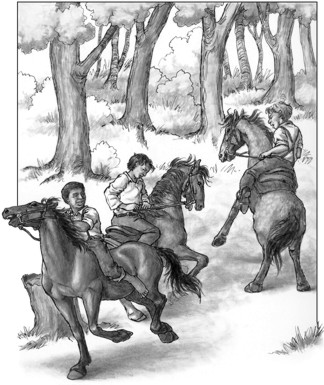
Danny kicked Wendell’s left side, sending his mount shooting right. Out of the corner of his eye, he saw the gray overshoot the stump and heard Tom hollaring, “Turn! Turn! You good-for-nothing bag o’ bones!” With the gray running straight, and Wendell splitting right, the roan seemed confused. Who to follow?
Danny didn’t wait. This was his chance. “Home! Home!” he hissed, lying low over Wendell’s neck, tasting clumps of black mane in his mouth. Beneath his legs, he felt a surge of power as Wendell regained the road. “Home!” he yelled. A twinge of guilt tickled his conscience. Yes, they were headed “home,” but no way was he going to let Wendell run all the way back to the Douglass home—not just yet.
In a few minutes, it was all over. With thundering hooves, Wendell sailed past the cap in the road, the gray and the roan trailing five or six lengths behind. Hauling on the reins with all his might, Danny yelled, “Whoa! Whoa!” But Wendell would have none of it. He was heading for home.
Finally running Wendell off the road and turning him in a wide circle, Danny trotted back to where Tom and Sam sat their wheezing horses, glaring at him. Danny just smiled. “Beat ya. Fair and square.”
Tom slid off the gray and snatched up his cap. “All right. So your nag can run. How ’bout you? Can you run?”
Danny’s throat seemed to constrict and cut off his air.
“Cat got your tongue, boy?” Tom leered. “I’m challenging you to a foot race. Right here. Right now.”
Now Danny’s heart was pounding. His neck veins throbbed. Licking his dry lips, he tried to find his voice. “Can’t,” he squeaked. “Gotta get this horse back to the Douglass place. Maybe ’nother time.”
Tom’s eyes narrowed. “Not another time. Now! We did your challenge—only fair for you to do ours.”
“Sorry,” Danny mumbled, pulling on the reins to turn Wendell around. “Gotta go.”
“I—said—now!” With a swift movement, the tall boy grabbed Danny’s pant leg and pulled. Taken off balance as Wendell moved the other way, Danny tumbled to the ground and hit the dust. He scrambled to his feet, still holding on to the reins, running in little hop-steps as Wendell danced away.
Tom and Sam were staring at Danny’s bare feet. Then they started to laugh. “Why, you got yourself a clubfoot, there, boy. Ha, ha, ha!” Danny’s face flamed with heat as the two white boys doubled over, pointing at his right foot. “Ho! Ho! You’re nothin’ but a cripple. Can’t even walk straight, much less run. Ho! Ho! Ho!”
Gritting his teeth, Danny grasped two handfuls of black mane and hauled himself onto Wendell’s back. It took all his willpower to hold back the words he would have liked to spit back in their leering faces. But it wouldn’t do any good—just lead to a fight. And two to one weren’t odds in his favor.
To his chagrin, the two boys followed twenty yards behind him as he headed south on St. Paul Road—just close enough for him to hear their taunting laughter. Danny held Wendell to a slow trot, trying to cool him down before reaching the lane leading up to the Douglass’s rambling ten-room house. As he turned into the lane, he could hear the parting taunts behind his back as the two boys rode past: “Cripple! Turtle!”
Tears stung Danny’s eyes as he slid off Wendell’s bare back at the stable. He brushed them away angrily with the back of his hand and busied himself rubbing down the sweating horse with a fistful of straw, forking fresh hay into the mangers for both Wendell and William, and hauling water from the well for their water buckets. His clubfoot gave him an awkward gait, but he prided himself on doing his chores quickly.
Maybe he couldn’t run a foot race, but he was no turtle.
Done at last with his stable chores, Danny splashed his face with well water and headed for the kitchen door. Mrs. Douglass always had something for him to eat before he set out for home. No one was in the kitchen, but he could hear voices at the front end of the house. Passing through the dining room, he saw a table set with the Douglass’s good Blue Willow china. His spirits picked up, remembering he and his Uncle Thomas had been invited to stay for supper tonight at the Douglass home. Some kind of anniversary; he couldn’t remember what for. His stomach growled in happy expectation. Uncle Thomas was all right—but he couldn’t cook like Anna Douglass!
Then the voices at the front end of the house became clearer—Frederick Douglass, for sure. No mistaking that booming voice. And . . . must be Lewis, the Douglass’s oldest son. Even from the dining room, Danny couldn’t help but hear the rising argument.
“Panama?” boomed the older Douglass. “We’re in the middle
of a Civil War in this country! Slavery’s got its head on the chopping
block, and you want to run away to Panama?”