
Chapter 1
The Man in the Buffalo Robe
Perrin Whitman ran into the house and tossed a folded copy of the Daily Tribune onto his father’s lap. "Is this about Uncle Marcus?" Perrin asked excitedly, brushing a hank of blond hair out of his eyes.
His father’s eyes scanned slowly down the article written by the famous publisher Horace Greeley. "Why, I do believe it is," he said slowly. "I didn’t even know my brother was back from the frontier. What’s the date of this paper?" He flipped the folded pages over: "March 29, 1843. That’s just last week!"
"He must have traveled cross-country right in the dead of winter," offered Perrin.
"But I don’t see how that’s possible . . . not from Oregon. From what I’ve heard, the snows in the mountains can get as deep as the eaves on a house, and in the prairie it drifts something terrible."
"Yeah, and how about Indians?"
Samuel Whitman looked back at the newspaper in his hand. "This says Marcus looks like a ragged mountain man in buckskin clothes with frostbite scars all over his face."
"And look," Perrin added, stepping to the side of his father’s chair and pointing to a paragraph in the middle of the article. "He had a meeting with the President of the United States looking like that."
"Yes. Well," the man said, rubbing his hand across his clean-shaven chin, "I’ve heard that President Tyler is getting more and more interested in the ‘Oregon Territory,’ as they’re calling it now."
"You think Uncle Marcus will come see us, Papa?"
"I should hope so, Son. After all, Rushville is his hometown, even if it’s stuck way out here in western New York. But I don’t know how we’ll entertain him, what with your mother gone and all." Samuel put the paper down, got up from his chair, and walked to the window to hide the tears in his eyes. "She always admired your uncle and hoped you’d be a missionary like him some day."
It had only been a year since Samuel Whitman’s wife had died. Since then, it hadn’t been easy making a living and keeping house for four children. At almost thirteen, Perrin was the oldest and a good worker, but in the small town of Rushville, there weren’t many jobs to keep a growing boy busy. He had to think of the boy’s future. . . .
G G G G
Four days later, when the light of a miserable, drizzly afternoon had almost faded to darkness, Perrin and four friends stood shivering on the porch of the Rushville Mercantile store.
They had almost given up their wait when Perrin announced, "Here it comes."
Sure enough, down the glistening, slippery street rumbled the twice-weekly stagecoach. Steam rolled off the wheezing horses as they were hauled to a stop in front of the town’s main store. The stage was so covered with mud that its red paint could only be seen around the top of the coach. The driver jumped down and walked stiffly toward the store with a mail pouch over his arm.
"He ain’t coming," whispered one of the boys.
"Hey, mister," called Perrin after the driver, "you got any passengers?"
"Well, there was one feller who climbed in back at Canandaigua. I ’spect he’s still there."
The boys stood staring at the coach, still rocking back and forth on its leather suspension straps. Suddenly, the door creaked and swung open. Out backed a huge furry creature that looked like a bear with boots.
Together, the boys stepped back into the shadows of the Mercantile’s porch. When the figure, who had been wrestling with a case inside the coach, pulled it free and turned around, the boys saw that it was not a bear but a man—a lean, tall man, made larger than life by the bulk of the great hairy coat that he wore. "That’s a buffalo coat," whispered Perrin.
"And he’s wearing a fur cap, just like the mountain men," offered one of the other boys.
"That’s ’cause he is a mountain man, stupid," said Perrin. "I told ya!"
Perrin had not seen his uncle since Marcus Whitman had left to start a mission to the Indians in the wilderness of Oregon seven years before. With him had gone his new wife, the beautiful Narcissa Prentiss; another couple, Henry and Eliza Spalding; and a fifth person, William Gray. Narcissa Whitman and Eliza Spalding had gained great fame in the East because they had been the first white women to cross the continental divide. Before they crossed the Rocky Mountains, the only white families to settle in the West were the few wealthy enough to travel by ship around South America and up the coast to live in coastal cities like Los Angeles or San Francisco.
But seven years is a long time to remember the face of a person you saw last when you were only six years old. Perrin stared hard at the man who stepped up on the porch. The dim light coming out of the store window showed a tall man with a lean, square face and a rough beard. His nose was straight and his eyes were deep set, and there were—as the newspaper article had said—dark frostbite blotches on his cheeks.
"Uncle Marcus?" ventured Perrin.
"Who’s that?" rumbled a deep voice as the man turned toward the shadows where the boys were hiding.
"Perrin . . . Perrin Whitman, sir. I came to meet the stage and walk you home."
"You don’t say. Well, if you’re my true-to-blood nephew, come out here in the light where I can see you."
Perrin stepped forward and shook his uncle’s outstretched hand. Then he quickly called his friends forward. They would owe him one if they got to shake hands with a frontiersman as famous as Doctor Marcus Whitman.
The next day was Sunday, and the four boys in front of the store weren’t the only people in Rushville who wanted to see Doctor Whitman. The minister arranged for the doctor to speak in church, and nearly the whole town attended, filling all the pews and standing around the back.
As usual, the flue for the wood stove wasn’t working properly, and the sunlight shining through the tall windows along the south side of the sanctuary cut bright angling paths through the smoky atmosphere of the small church. Once the congregation had sung all four verses to five hymns—all of them about missions—the wheezing sound of the pedal-pumped organ came to a halt, and the minister stood to announce the speaker: Doctor Marcus Whitman, Rushville’s own missionary to the far reaches of the western wilderness.
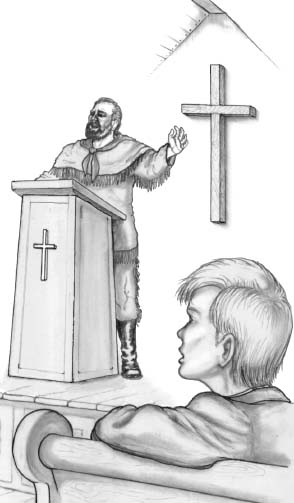
Uncle Marcus stepped up to the pulpit. Even though Perrin’s father had offered to loan Uncle Marcus a black suit for Sunday "so you won’t offend anyone," the frontiersman had dressed in his buckskins. "They’re a lot more comfortable than store-bought clothes," he had told Perrin, "even though I’ll admit they smell a might strong after wearing ’em for six months."
Perrin, who usually sat with his friends in the back row in church, had his buddies with him in the front row to hear his uncle.
"We have very little time to convert the Indians of the Northwest to Christianity," Doctor Whitman began. "Just twelve short years ago, four brave Nez Perce Indians traveled on their own over twelve hundred miles from the Oregon Territory all the way down to St. Louis. Did they come to trade beaver pelts? No. Did they come to buy liquor? No. They came to ask for THIS!" Marcus shouted, holding his battered black Bible high above his head.
"They wanted Bibles and someone to come and explain the Gospel to them. Can you imagine that, brothers and sisters? People asking for missionaries to come and tell them how to know God! How will we ever answer our Lord in heaven concerning His command to preach the Gospel if we do not at least go to people who are asking to hear?
"I, myself, received such a call. Four years later Reverend Parker and I attended the trappers’ rendezvous on the eastern slopes of the Rocky Mountains. Along with all the wild trappers of the Northwest, nearly two thousand Indians were gathered there. On the very day that I arrived, I operated on a famous mountain man named Jim Bridger and removed a three-inch, barbed arrowhead that had been lodged in his back for three years. Many Indians watched and were amazed by Bridger’s recovery. After that I was constantly busy doctoring trappers and Indians alike.
"A few days later, at a conference with the chiefs, Reverend Parker explained why we had come: We were exploring the possibility of starting a mission among the Nez Perce Indians in answer to their request.
"Now, brothers and sisters, I want you to listen closely to what the Indians said. The head chief stood up and said, ‘We have heard of the coming of a teacher from the Almighty in the company of a remarkable medical man. That is why we came to this rendezvous. I have been told something of the worship of God, but that is all. But if a teacher will come among us, I and my children will obey all that he says.’
"Can you believe that, brothers and sisters? What faith, what openness, what an invitation!" Doctor Whitman shouted as he reached in the air with both arms like he was welcoming the whole world. Then in a quiet, worried voice, he continued, "But we are in danger of losing our opportunity with the Indians. The day of the noble savage who can ride wild and free across the land is nearly gone. If the Indian does not accept the ways of the white man, he will be wiped out. You have seen it here in the East, and it will soon happen in the West. Civilization—our civilization, that is—is spreading. White men bring whiskey and rum and barbed wire, and we kill the game.
"I am committed not only to sharing the Gospel with the Indians but to preparing them so they can survive the advancement of civilization. Indians on our mission station are not only being converted and baptized, but they are learning how to farm and raise cattle. We’re getting them ready to endure the arrival of the white man.
"But we need reinforcements. We need your help!" he urged.
Perrin heard very little of the rest of what his uncle said. His mind was spinning with visions of high mountains and wild Indians riding like the wind through the sage brush. He wanted to be a part of that adventure. He wanted to go west!
That afternoon around the dinner table, his uncle explained more about why he had come back east. The Presbyterian mission board had threatened to shut the Waiilatpu mission down at just the time Marcus felt it should be expanded.
"The settlers are starting to come," he said urgently. "When Narcissa and I went west, no one thought a family could cross the Rockies. Last year eighteen wagons with over a hundred people pulled into our mission station. Half of them were sick and nearly starved, but there they were, in Oregon. And I was glad to see them."
"But this morning," said Perrin’s father, "I thought you said the arrival of settlers was going to destroy the Indians. How can you be glad to see them?"
"For this reason," explained the missionary. "Great Britain wants to lay claim to the Oregon Territory, and the Hudson’s Bay Company has been there for years with its forts and fur traders. Why, Lord Ashburton is down in Washington right now trying to negotiate a treaty to get Oregon for England. That’s why I went to see the President. We can’t let England have Oregon!"
"But what good will settlers do?" asked Samuel Whitman.
"Settlers are America’s claim on Oregon. If we have enough United States citizens in the area, the government will never surrender it to England. If we don’t, then the British and their Hudson’s Bay Company will take over.
"What I want is the right kind of people to come to Oregon. I’ve been trying to get the Presbyterian mission board to send funds for founding more schools. I want good people to come as missionary settlers and teachers and helpers."
Perrin saw his chance. "I’ll go, Uncle Marcus," he said eagerly.
"What we need are . . ." Marcus stopped in midsentence and looked at young Perrin. He turned nervously to Perrin’s father and slowly continued. "What we need are people who care more for the Indians’ souls than their land."
"That’s me," said Perrin, again trying to edge his way into the conversation. "I don’t want any land, but I could help around the mission. There’s a lot of things I can do. Isn’t that right, Papa? It’d be one less mouth to feed . . . and Lucy could help take care of the younger kids."
There was an awkward silence as the Whitman brothers looked at each other. Finally, Perrin’s father said, "I suppose I could get along without you . . . for a while. But I don’t think Marcus had young lads in mind when he called for helpers."
"Now hold on there, Samuel," said Marcus. "The frontier makes a man out of a boy pretty fast, and Perrin, here, seems to have gotten a pretty good start. I wouldn’t mind taking him with me . . . if you could let him go."
"Oh, please, Papa, please!"
"But . . . would he be safe?" asked Perrin’s father, slowly taking the boy’s request seriously.
"Well, nothing’s really safe on the frontier," Marcus admitted. "There’s always the possibility of an accident or something."
"I mean the Indians," said Samuel. "They’re savages, aren’t they?"
"Well, yes. By our standards they may be savages. They live wildly, by hunting and riding horses. Samuel, I have never in my life seen better horsemen than the Nez Perce. You should see them—"
"That’s not what I mean," interrupted Perrin’s father.
"No. I suppose it’s not. But what can I say, Samuel? They’re family people; they’re a peace-loving people. But they’re being pushed by the white man, and sometimes . . . sometimes there’s tension. But do you know what our mission is called? Waiilatpu. In Nez Perce, that means the place of the rye grass. There’s not a more beautiful, peaceful valley in the whole Northwest. Perrin will be fine."
"I suppose it might do him some good," said Samuel thoughtfully. He turned to his eager son. "But mind you, now, I want no complaining when the going gets rough."
Perrin could hardly believe it. His father was saying yes! He was going to Oregon!
© 1994 Dave and Neta Jackson