
Chapter 1
The Forest Hideout
(Palawan
Island, Philippines, 1942)
Four-year-old Alastair clung tightly to his daddy’s broad shoulders as Sandy Sutherland scrambled up the steep footpath. “Hang on, laddie,” said his father. “We’re almost to the clearing.”
Alastair looked back and saw his mother struggling up the rocky path behind them, carrying two-year-old Heather on her hip.
“Will Bertie be there?” asked Alastair, ducking his head to avoid some big ferns along the path.
His father hesitated just a moment before saying softly, “By God’s guid graces, aye, laddie.”
Because of “the war,” the Sutherlands and their friends the Edwardses had been living for months in the rain forest that covered the mountains on Palawan Island. Six months earlier, just before Christmas, the news had crackled on the radio: The Japanese had dropped bombs on Manila, the capital city of the Philippine Islands—right after bombing American ships at Pearl Harbor, Hawaii. “America has declared war on Japan!” the radio announcer sputtered. “The war in Europe has become World War II!”
Alastair’s parents, Sandy and Maisie Sutherland, were Scottish Brethren missionaries who pastored a little church in the isolated town of Brooke’s Point on Palawan Island. Harry Edwards was an American businessman who lived in Brooke’s Point with his Filipino wife and their just-graduated-from-college son, Bertie. But with the bombing of Manila—even though Manila was five hundred miles away on Luzon, the largest of the Philippine Islands—the Sutherlands and Edwardses realized their lives were in danger. The two families rolled clothes and food into bundles and fled into the mountain forests.
Alastair squeezed his eyes shut and laid his head against his father’s warm back. He didn’t understand war. He didn’t understand why they had to live in the forest, moving from barrio to barrio, sleeping on the ground instead of in his own nice bed. The people in the different villages sometimes shared their rice and fish, but Alastair always felt hungry. He wanted to go home.
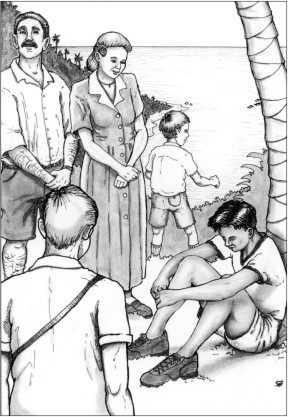
But today was Sunday, and by agreement the Sutherland and the Edwards families tried to meet on the Lord’s day for a time of worship and encouragement. The trail broke through a tangle of lacy ferns, vines, and bright tropical flowers and opened into a small clearing. A tall man in his sixties, standing at the edge of the clearing where the forest fell away sharply down to the sea, looked through a pair of binoculars.
Harry Edwards turned and gave a brief, tired smile as the Scottish family came and stood beside him. “You heard?” said the American.
“Aye,” said Sandy Sutherland. “The Japanese defeated the Americans at Corregidor Island. It’s . . . only a matter of time now.”
Alastair peeked over his father’s shoulder. The town of Brooke’s Point lay below them, caught like a pearl between the bright blue waters of the Sulu Sea and the steep mountains that ran like a bony spine down the length of Palawan Island. The bay was empty. Alastair remembered watching the vintas, or outrigger fishing canoes, go out each evening, their colorful sails muted by the long shadows cast by the mountains. Even more exciting was the occasional steamboat that traveled from island to island, bringing passengers or picking up sacks of bananas, coconuts, bamboo, rattan, and almaciga gum to sell in the cities. But no steamships had come to Brooke’s Point for months.
The sandy-haired four-year-old wiggled down from his perch on his father’s back. “Where’s Bertie?” he piped up—then he saw the young man, who was in his early twenties, half-sitting up with his back against a coconut palm at the edge of the clearing. Mrs. Edwards, her long dark hair swept up into a knot on the back of her head, knelt beside her son, mopping Bert’s sweaty face.
Bert Edwards was Filipino-American. A year ago he had graduated from the University of Illinois in the United States with a degree in farming. He had come home to Palawan Island full of ideas how to help the mountain tribespeople grow more food. But Alastair was worried about his friend, who was kind of like a “big brother.” Bertie had been sick with malaria twice already since he got home from college, and he looked very sick again.
“Hey, Ali,” Bert said with a weak grin as the little boy hunched down beside him. “How’s my buddy?”
“How are you, Bertie, is more like it,” said Alastair’s father as the rest of the Sutherland family and Harry Edwards also came over to the tree Bert was propped against.
Bert rolled his feverish eyes mockingly. “Never better,” he joked—and then was overcome by a fit of coughing.
“He’s got blackwater fever now, Pastor!” said Mrs. Edwards desperately. “We don’t have any quinine to give him, no dry clothes—we can’t keep going like this!”
“Mama . . . please,” Bert begged. “It’s all right. I need to talk to the pastor about something.”
Sandy Sutherland crouched down next to Alastair and rested an arm on one knee. “Aye, Bert, what is it?”
Bert tried to take a large breath. “Remember . . . remember when I was telling you all my grand ideas about teaching the mountain tribespeople modern ways to grow more food? You said, ‘They also need spiritual food, Bert. But they have no written language, no Bible. How—’” The young man stopped, exhausted. After a few moments he went on. “‘How are they going to learn about Jesus?’ you said.”
Sandy Sutherland nodded. It was true. On Palawan Island alone there were eighty-seven different dialects among the mountain tribespeople.
Bert managed another grin. “Well, I’ve got an idea. At college the guys and gals listened to records all the time and knew the words to all the songs they listened to. Why not . . . why not make gospel records in . . . in the Palawano language, for instance. Most of the tribes know some Palawano—they use it for trading with each other. If every barrio had a record player and some gospel records, they could hear the Gospel, even if they can’t read!”
Alastair saw his father and Mr. Edwards exchange surprised glances. “That is quite an idea, Bertie,” Sandy Sutherland said. “I wonder how . . .”
Alastair sighed and got to his feet. It just wasn’t the same since they’d been hiding in the forest. Nobody laughed and played anymore. Bertie used to throw him up in the air and let him ride on his back, like a pony. If only they could go home and live in Brooke’s Point again, Bertie would get well, and things would be like they used to be.
Alastair wandered over to the far side of the clearing and looked down the mountainside at the town far below. Then he saw something out on the bay. Specks moving toward shore . . .
“Papa! Mr. Edwards!” the little boy cried out, pointing down toward the bay. “I see boats! The fishermen are coming back! The fishermen are coming back!”
In a few strides Harry Edwards and Sandy Sutherland had crossed the clearing. The American peered intently at the specks on the bright blue water with his binoculars. “Those aren’t fishing boats,” he said, handing the binoculars to the missionary. “What do you think, Sandy?”
Alastair’s father looked long and hard through the glasses. Then he lowered them. “Soldiers,” he said. “Japanese. Some of them have landed already and are going house to house.”
“Mummy!” whimpered two-year-old Heather.
Maisie Sutherland scooped up the little girl in her arms. “Oh, Sandy! We can’na stay here. We have to go farther up the mountain. But—” She looked back toward the sick young man under the coconut tree. “But what about Bert?”
Frightened, Alastair looked from his father to his mother to Mr. Edwards and back again. What was happening? Why was everyone so upset all of a sudden?
“Don’t worry about us,” said Harry Edwards firmly. “You folks go on ahead. We’ll be all right.”
“No one’s gaing anywhere until we have our ain worship together,” said Sandy Sutherland firmly. “That’s what we came fer, and that’ll be what we do.”
The two small families gathered under the leafy palm branches of the coconut tree. Sandy Sutherland took his Bible out of his pocket and turned to the book of Habakkuk. “‘Although the fig tree shall not blossom,’” he read in his rich, Scottish voice, “‘neither shall fruit be in the vines . . . the flock shall be cut off from the fold, and there shall be no herd in the stalls: Yet I will rejoice in the Lord! . . . The Lord God is my strength, and he will make my feet like hinds’ feet, and he will make me to walk upon mine high places.’”
“What does ‘like hinds’ feet’ mean?” Alastair whispered loudly, tugging on his father’s arm.
“It means like the nimble feet of a deer bounding up a mountainside,” Sandy Sutherland said with a chuckle. “A guid Scripture fer arr situation, don’na you think?”
“Yes,” said Maisie Sutherland softly. Little Heather’s curly head was buried in her neck. “Even though nothing is going right—we will still rejoice in the Lord.”
Sandy Sutherland again knelt on one knee beside the sick young man. “Bert,” said the missionary pastor gently, “the Japanese have landed at Brooke’s Point. We don’t have much time to be together this mornin’. But do ya have a favorite song ye’d like us to sing?”
Bert’s feverish eyes burned bright. “‘Count Your Blessings’—please sing that one.”
The missionary pastor smiled at Bert’s choice. His rich, baritone voice started on the first verse, and the others joined in . . .
“When
upon life’s billow you are tempest tossed,
When
you are discouraged thinking all is lost;
Count
your many blessings, name them one by one,
And
it will surprise you what the Lord hath done!”
The little group couldn’t help smiling at one another as they belted out the chorus: “‘Count your blessings! Name them one by one!. . .’”
Down in the town of Brooke’s Point, the Japanese soldiers had set up camp, taking over the pleasant homes of the Edwardses and the Sutherlands for their headquarters. At the end of a street lined by pretty little bamboo houses on stilts, the sturdy chapel was empty.
Somewhere deep in the forest, two families—one American, one Scottish—climbed farther up the mountains, not knowing if they’d ever see their homes again. And even though they’d lost someone dear to all of them, there was a song in their hearts that they hummed and whispered to encourage one another: “Count your blessings, name them one by one. . . .”
© 1999 Dave and Neta Jackson