Chapter 1
Stranger in Town
The town of Acorn popped into view as the big, leggy mule rounded a stand of scrub pines and wild briar, pulling the farm wagon behind him. Sitting beside his father on the driver’s seat and lightly holding the mule’s reins, Jesse Turner squinted ahead and groaned silently.
Wayne and Udall Buck were sitting on the porch of Dickson’s Seed ’n Feed, their chairs tipped back against the wall of the general store, where they had a good view of anyone coming or going along Acorn’s one dusty street.
“Them two,” Jesse heard his older brother, Lee, mutter behind him, riding in the bed of the wagon. “World be a better place if they was to drop off it.”
“You jest corral the young’uns, Lee, and don’t pay them Buck brothers no mind,” warned the boys’ father. “Jesse, pull Big Red round to the side.”
Jesse hollered, “Gee!” to the mule, then “Whoa!” Big Red obediently turned right into the shade of the Seed ’n Feed and stopped.
Scrambling down from the driver’s seat, Jesse hung back a little, letting his father go first. No sense being first in the line of fire. He saw that Lee, taking his time about helping nine-year-old Willy and five-year-old Kitty down from the back of the wagon, had the same idea.
“Waal, look who come to town, Udall,” smirked Wayne Buck, looking out from beneath a dirty felt hat and a shank of limp, greasy hair. “If’n it ain’t our darky neighbor an’ his litter o’ young’uns.” The older of the Buck brothers had a wide red face, with pale stubble on the lower half that never seemed to grow into a beard or get shaved off. His nose was too big for the rest of his face, making his tiny eyes look even smaller.
“Heh, heh, yeah, that right,” grinned Udall Buck, revealing several missing teeth. Wayne Buck’s “baby brother” was maybe thirty years old, and it was the Turner family’s opinion that Udall had something missing upstairs—not that it mattered much. Both brothers seemed to spend more energy swatting flies and bad-mouthing colored folks than working their farm.
“Mornin’, Mr. Wayne . . . Mr. Udall,” Cecil Turner said with a slight tip of his head, ignoring the brothers’ mocking tone.
“Y’all got money to spend today, Cecil? A special ’casion?” Wayne Buck needled.
“Nah,” piped up Willy. “We gotta ask Mr. Dickson for more cre—umph.” Lee clamped his hand over Willy’s mouth and practically dragged the little boy over the doorsill into the store. Jesse quickly herded Kitty after them. When was Willy going to learn to keep his mouth shut about family business! Especially to white folks like Wayne and Udall Buck.
As Jesse’s eyes adjusted to the dim coolness of the Seed ’n Feed, he felt Lee’s breath against his ear. “Wouldn’t I like to knock the chair legs out from under them Buck brothers and teach ’em a thing or two,” the older boy hissed.
Jesse pulled away and looked at his brother in alarm. Black people had been lynched for less in Bullock County, Alabama, even if it was 1898.
“Mornin’, Cecil!” came a friendly voice from behind the counter. “Look at how these youngsters are shootin’ up! Those boys are almost as tall as you, Cecil. How old are you now, Lee and Jesse?” Harry Dickson, the owner of the Seed ’n Feed, smiled a welcome as he rolled up his shirt sleeves. It was only nine o’clock in the morning but already getting hot for a Thursday in late May.
Lee didn’t answer, and that irritated Jesse. Mr. Dickson had always acted friendly to the Turners, even if he was white. Why did Lee have to be so sullen? Not everybody acted like the Buck brothers.
Jesse felt obligated to answer. “I was fourteen last birthday, Mr. Dickson. Lee here be seventeen now.”
“Seventeen. Is that a fact! Well, now, Cecil, did you come back to get more seed, plant those twenty acres you were holding back on? You oughta be able to manage forty acres with the help of these big boys.”
Cecil Turner removed his hat. “Oh, they a help, all right,” he said. “But . . . like I said las’ time I was in, Mr. Dickson, I can’t afford no more seed. Truth to tell . . .” Jesse’s father twisted the hat in his hands and glanced around the cluttered room nervously. “The wife needs some basic supplies—flour, sugar, salt, cloth to make dresses for the girls. They outgrowin’ the old ones. But . . .” The hat was twisted in unrecognizable form by now.
Jesse looked away uncomfortably. Willy and Kitty were studying the fat jars of candy sitting on a side counter. Lee was standing at the window with his back to his father and Mr. Dickson, pretending he wasn’t listening to the conversation.
“Well, you know I ain’t got no cash right now, Mr. Dickson,” his father’s voice went on behind him. “Last year’s harvest was right poorly. Fact is, uh, I need to ask for more credit.”
The silence probably lasted only five seconds, but it felt like five minutes. Then Jesse heard Mr. Dickson clear his throat. “Well, now, Cecil, you know I want to help you whatever way I can. But . . . last year’s harvest didn’t even pay off your bill from last year. If you keep buyin’ on credit, how are you ever gonna get ahead?”
It was awkward, standing still doing nothing. Jesse walked over to his little brother and sister. “You ain’t gonna get any candy,” he whispered fiercely, “so you might as well stop lookin’.”
“Don’t hurt nothin’ to look,” pouted Willy.
The two men’s voices had dropped, and Jesse had to strain to hear.
“Well, now, you know my offer still stands, Cecil,” Harry Dickson was saying. “I’m willing to buy your place, cancel the debt you owe this store, and give you some cash money besides. Your family can stay on and sharecrop. You can get what you need from the store, no questions asked; we’ll just settle up at the end of the year. That way we both share the burden when the harvest is poor like last year.”
Sharecrop. Jesse glanced anxiously at his father. Grandpappy George would go straight to his grave today if Papa ever gave away the forty acres George Turner, ex-slave, had gotten from the government after the Civil War thirty-some years ago.
“Land
. . . land! That’s what it mean to be free, owning your own land,” Grandpappy
George often said, fire burning in his dark eyes.
“Be your own master! Only legacy we got to pass on to these chil’ren. Don’t
matter what happen, son, don’t give up
the land.”
Jesse’s father laughed nervously. “That, uh, mighty generous, Mr. Dickson, sir. I ’preciates it. But you knows how my ol’ pappy is about that land. Would kill him outright if I sold it. No, no, I’m sure we goin’ to have a turn for the better. And you know I always pays you first.”
“Well, you think about it, anyway, Cecil,” said Mr. Dickson. “I’ll give you credit today. Dicksons and Turners go a long way back . . . gotta help a man out.”
Jesse and Lee exchanged glances. The Dicksons and Turners went a long way back, all right. It was Harry Dickson’s father who had owned the huge cotton and tobacco plantation in this part of Bullock County before the war, and Grandpappy George had been a slave on that plantation till he was forty years old. Back then it wasn’t “Mr. Dickson,” but “Master Dickson.” Even Papa had been born a slave, though he was just ten years old when the war ended and the slaves had been freed. After the war, the U.S. government had divided up some of the plantations and given some of the former slaves “forty acres and a mule,” though it was a slogan that fell far short of its promise.
Their grandpappy, George Turner, was one of the “lucky” ones.
But now that the negotiation for more credit had passed, the tension in Dickson’s Seed ’n Feed seemed to let out a breath. Cecil Turner counted off on his fingers the household goods they needed, while Harry Dickson started to pack them in an empty feed sack.
“Papa,” piped up Willy, “can we have some candy?” He was holding the jar of candy sticks. Beside him, Kitty’s eyes pleaded hopefully.
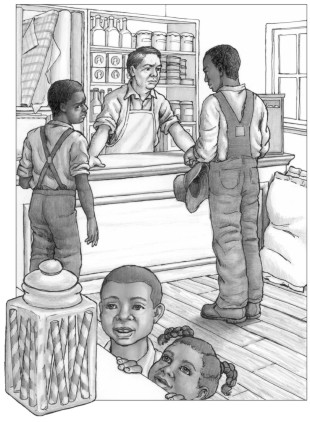
“Put that back,” snapped their father. “You know better’n that.”
Jesse whacked Willy’s arm with the back of his hand and glared at his little brother. Didn’t the boy have any sense at all? Putting Papa on the spot like that in front of Mr. Dickson.
“Well, now,” Harry Dickson broke in. His voice sounded like butter on hot corn. “Kids have got to have a bit of a treat now an’ then. Go on, Cecil, let the youngsters pick their favorite stick.”
Cecil Turner turned to the storekeeper and smiled uncertainly. “Well, now, Mr. Dickson, sir, that’s mighty nice, but—”
“No, no, it’s no problem,” said the storekeeper. He chuckled as Willy selected a green winterberry flavor and stuck it in his mouth. Eyes dancing with excitement, Kitty picked a pink peppermint stick. “No problem at all,” Harry Dickson repeated. “I’ll just add it to your bill, you don’t even have to worry ’bout it till you come in to settle up.”
Jesse saw the smile freeze on his father’s face. It was too late now to tell the children to put the candy back. Both were sucking happily on the sticky sweets.
“Now, what else does Jenny need?” prompted Harry Dickson.
“Uh . . . oh yeah, six yards of plain muslin . . .”
Jesse wandered over to the window where Lee was smoldering. He could read his big brother like Mama could read a book, and he knew Lee was angry. Jesse hoped Papa got finished soon so they could go home before Lee popped off and said something that would get them all in trouble.
Something outside caught his eye. “Look at that, Lee,” he said.
An odd-looking wagon was rolling into Acorn from the direction of Union Springs, the next largest town ten miles up the road. Two black men Jesse had never seen before were sitting on the driver’s seat. The man driving the mule was tall and gangly, maybe thirty years old, wearing a dark, rumpled suit, and sporting a good-sized moustache. Next to him rode another black man, wearing a fancy maroon suit with a starched white shirt and black silk tie, and holding a big satchel on his lap like he was traveling someplace.
Lee glanced out the window. “What of it?” he asked sullenly.
“Never seen those men before,” Jesse said in a low voice. “Wonder what they got in that wagon? Look at all those buckets with plants growin’ in ’em . . . lots of glass jars, too.” A movement caught his eye, accompanied by the sound of two sets of chair legs hitting the wooden porch outside the Seed ’n Feed with a thud. “Uh-oh.”
“What?”
Jesse didn’t have to answer. The sound of Wayne Buck’s ornery voice carried through the open door.
“You there in the wagon. Stop it right there! What’s yo’ business here?”
“Yeah,” Udall Buck chimmed in. “We don’t take kindly to strangers round here.” The sneer in his voice thickened. “‘Specially no fancy-pants darkies from up north.”
The wagon had pulled to a stop a few feet from Dickson’s Seed ’n Feed, and the nattily dressed man in the maroon suit swung down with his big leather satchel.
Jesse felt his father’s presence come up behind them. “What’s goin’ on out there?” said Cecil Turner. He sounded tired.
“I dunno, Papa,” said Jesse. “Strangers. The Buck brothers out there givin’ ’em a hard time.”
Cecil Turner leaned past his boys and peered intently out the window. “Who in—? Why, that’s—”
Suddenly the boys’ father charged out the door. Following uncertainly, Jesse and Lee—followed by the two youngest Turners still sucking on their candy sticks—crowded into the doorway of the store. To their surprise, their father and the man in the fancy maroon suit were slapping each other’s backs and giving bear hugs. Wayne and Udall Buck stopped swaggering and looked on uncertainly, frowns etched into their red faces.
“Chil’ren!” their father called out. “Come on out here. This ain’t no stranger! This here my baby brother . . . back after ten years in Philadelphia. Come on, now. Meet yo’ uncle Howie!”
© 2000 Dave and Neta Jackson